
Explore the British Museum in 2026. Discover history, famous artifacts, visitor tips, exhibitions, and why millions visit yearly.
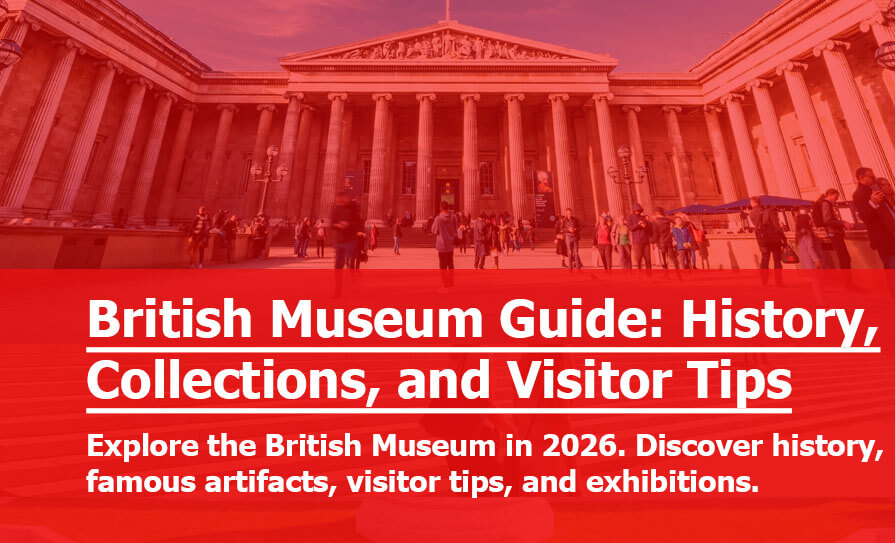
British Museum Guide 2026
The British Museum is one of the world’s most famous museums and one of the most visited cultural landmarks in Europe. Located in the heart of London, the museum houses more than eight million objects spanning human history, ancient civilizations, art, religion, science, and archaeology. Visitors travel from every corner of the globe to see legendary artifacts such as the Rosetta Stone, Egyptian mummies, Parthenon sculptures, Samurai armor, and ancient manuscripts that shaped civilization itself. Admission to the permanent collection remains free, which makes the British Museum not only historically important but also remarkably accessible for students, tourists, researchers, and families.
The museum’s influence stretches far beyond tourism. It stands as a symbol of imperial history, academic research, cultural preservation, and global debate about ownership of historical artifacts. Some visitors walk through its galleries in awe. Others leave reflecting deeply on colonial history and the movement of cultural treasures across continents. Few museums in the world provoke such admiration and controversy at the same time.
Founded in 1753, the British Museum grew from a modest collection into one of the largest repositories of human history ever assembled. Over the centuries, explorers, archaeologists, diplomats, and collectors brought artifacts from Asia, Africa, Europe, the Middle East, Oceania, and the Americas into its halls. Today, the museum functions as both a tourist attraction and a serious academic institution visited by researchers from around the world.
The British Museum also plays a major role in the study abroad experience for international students in the UK. Students studying history, archaeology, anthropology, politics, literature, classics, museum studies, and art history often spend hours inside its galleries. The museum becomes more than a sightseeing destination. It becomes a living classroom where civilizations speak silently through stone, gold, papyrus, bronze, and ink.
This detailed guide explores the history of the British Museum, its most famous collections, visitor statistics, controversies, educational value, nearby attractions, ticket information, travel advice, and why it remains one of the most important museums on Earth in 2026.
History of the British Museum
The British Museum officially opened in 1759, though its roots trace back to physician and collector Sir Hans Sloane, whose enormous collection of books, manuscripts, artifacts, and natural specimens formed the museum’s foundation. Sloane believed knowledge should remain publicly accessible rather than locked inside private aristocratic collections. His vision shaped the institution’s early identity and transformed cultural access in Britain.
During the eighteenth and nineteenth centuries, the British Empire expanded across large parts of the world. As Britain’s political and military influence grew, the museum’s collections expanded rapidly. Archaeologists, diplomats, explorers, and colonial administrators transported artifacts from Egypt, Greece, Mesopotamia, India, Africa, and beyond into London. Some acquisitions occurred through excavation agreements and purchases. Others remain deeply controversial today.
The museum’s architecture evolved dramatically across centuries. The famous Greek Revival facade and grand columns gave the institution an almost temple-like appearance, reinforcing its role as a guardian of civilization and historical memory. In 2000, the stunning Great Court designed by Norman Foster modernized the museum with a spectacular glass roof that became one of London’s most recognizable interior spaces.
The British Museum survived extraordinary historical upheavals, including both World Wars. During the Second World War, many precious artifacts were evacuated to safer locations to protect them from bombing campaigns targeting London. The museum itself suffered structural damage, yet much of its priceless collection survived because of careful preservation efforts.
Compared with previous decades, the museum today operates within a far more globally connected and politically sensitive environment. Conversations about colonial history, repatriation, cultural ownership, and ethical collecting practices increasingly shape public understanding of the institution. The British Museum therefore exists not merely as a building of artifacts, but as a continuing debate about history itself.
British Museum Visitor Statistics and Popularity
| Year | Estimated Visitors |
|---|---|
| 2019 | 6.2 million |
| 2020 | Major decline due to pandemic |
| 2021 | Gradual recovery |
| 2022 | Over 4 million |
| 2023 | Over 5 million |
| 2024–2025 | Continued growth |
The British Museum consistently ranks among the most visited museums in the world. Before the global pandemic, annual visitor numbers surpassed six million people regularly, placing the museum alongside institutions like the Louvre Museum and the Metropolitan Museum of Art in global cultural importance.
The pandemic years disrupted tourism dramatically. International travel restrictions reduced visitor numbers sharply between 2020 and 2021. Empty galleries replaced the enormous crowds once filling the Great Court daily. Yet the museum adapted quickly by expanding digital exhibitions, virtual tours, online lectures, and educational resources for global audiences unable to travel physically.
By 2023 and 2024, visitor numbers rebounded strongly as international tourism recovered. London’s enduring popularity as a global city helped accelerate this recovery. Students, tourists, historians, researchers, and casual travelers once again returned in large numbers to experience the museum’s collections firsthand.
One remarkable aspect of the museum’s popularity involves its free permanent admission policy. Unlike many major museums charging expensive entry fees, the British Museum allows visitors to explore core galleries without payment. This policy preserves accessibility for students, families, and travelers operating on tight budgets.
Compared with previous generations, modern visitors also engage differently with museums. Social media transformed the British Museum into both an educational destination and a visual cultural symbol. Images of Egyptian statues, marble sculptures, and the Great Court circulate constantly across Instagram, TikTok, YouTube, and travel blogs, drawing younger audiences into spaces once viewed as formal or intimidating.
Most Famous Artifacts in the British Museum
The British Museum contains countless treasures, yet several artifacts stand above the rest in global fame and historical importance. These objects attract millions of visitors yearly because they connect directly to ancient civilizations and pivotal moments in human history.
The Rosetta Stone remains perhaps the museum’s most iconic object. Discovered in Egypt in 1799, the stone carried inscriptions in Greek, Demotic, and hieroglyphics. Its decipherment unlocked ancient Egyptian writing systems and transformed Egyptology forever. Crowds constantly surround the display case because visitors recognize they are standing before one of history’s greatest linguistic breakthroughs.
Egyptian mummies also captivate visitors deeply. The museum houses one of the world’s largest collections of ancient Egyptian artifacts outside Egypt itself. Sarcophagi, burial masks, statues, jewelry, and preserved human remains reveal extraordinary details about religion, death rituals, medicine, and daily life thousands of years ago.
The Parthenon Sculptures, often called the Elgin Marbles, remain among the museum’s most controversial holdings. Originally part of the Parthenon temple in Athens, these sculptures continue fueling international debates about cultural ownership and repatriation. Greece repeatedly requested their return, while the museum argues they belong within a universal world collection.
Other remarkable highlights include Assyrian lion hunt reliefs, Samurai armor, Aztec mosaics, Chinese ceramics, Viking treasures, African bronzes, and medieval manuscripts. Walking through the museum feels less like visiting one country’s history and more like traveling through the memory of human civilization itself.
Why the British Museum Matters for Students
For students studying abroad in the UK, the British Museum often becomes more than a tourist stop. It transforms into an intellectual sanctuary where textbooks suddenly become tangible reality. History stops feeling distant when you stand inches away from objects created thousands of years ago.
Students studying archaeology, anthropology, ancient history, politics, religion, literature, and museum studies benefit especially from repeated visits. Professors across London universities frequently organize museum-based seminars because the collections provide direct access to historical evidence impossible to replicate fully through classroom lectures alone.
The museum also teaches something subtler about civilization and power. Students encounter artifacts from conquered empires, lost kingdoms, sacred rituals, and vanished languages. Walking through these galleries reveals how human ambition, trade, war, religion, migration, and creativity shaped the modern world across thousands of years.
International students often describe the British Museum as emotionally overwhelming during their first visit. Seeing artifacts previously known only from documentaries or textbooks creates a strange sensation. Ancient civilizations suddenly feel less abstract and more deeply human. A cracked statue or faded manuscript can bridge centuries more powerfully than lectures ever could.
Compared with previous generations, students today also engage critically with museums themselves. Modern academic discussions increasingly examine colonial collecting practices, ethical preservation, repatriation debates, and institutional accountability. The British Museum therefore functions simultaneously as educational resource and subject of intellectual debate itself.
British Museum Controversies and Repatriation Debates
The British Museum stands at the center of some of the world’s most heated cultural debates. Admirers describe it as a universal museum preserving humanity’s shared history in one place. Critics argue that many objects inside its galleries arrived through imperial expansion, unequal treaties, military conquest, or colonial pressure. Both arguments continue shaping international discussions today.
The Parthenon Sculptures remain the most famous example. Greece has repeatedly requested the return of these marble sculptures to Athens, arguing they form an inseparable part of Greek cultural heritage. British authorities historically defended the museum’s legal ownership claims, though conversations around potential agreements intensified in recent years. The debate stretches beyond law. It touches identity, memory, and national pride.
Another major controversy involves the Benin Bronzes taken from present-day Nigeria during the British military expedition of 1897. Museums across Europe and North America faced increasing pressure to return looted African artifacts. Some institutions already transferred pieces back to Nigerian authorities, while the British Museum continues negotiating complicated legal and political considerations surrounding ownership and preservation.
Supporters of the museum often argue that global museums allow millions of international visitors to encounter world civilizations within one institution. They claim such collections encourage cross-cultural understanding and global education. Opponents counter that this reasoning sometimes ignores the historical violence or inequality surrounding how objects originally left their countries.
Compared with previous decades, repatriation debates became dramatically more visible during the 2020s. Social movements, postcolonial scholarship, and changing public attitudes pushed museums worldwide toward greater transparency regarding acquisition histories. The British Museum increasingly operates under intense international scrutiny, and these conversations are unlikely to disappear anytime soon.
British Museum Architecture and Design
Walking toward the British Museum feels almost ceremonial. Massive stone columns rise above visitors like a classical temple guarding centuries of memory. The architecture intentionally projects permanence, authority, and intellectual grandeur. Even before entering the galleries, visitors sense the institution’s enormous historical weight.
The museum’s neoclassical facade reflects architectural influences from ancient Greece and Rome. Designed primarily during the nineteenth century, the structure aimed to symbolize enlightenment ideals, scholarship, and civic access to knowledge. Large museums of that era often resembled temples because society viewed learning almost as a sacred pursuit.
Inside, the Great Court transformed the museum dramatically after renovations completed in 2000. The enormous glass roof floods the central courtyard with natural light and softened what once felt like a labyrinth of enclosed halls. Visitors frequently pause beneath the ceiling simply to admire its geometric beauty and scale.
The Reading Room, located at the center of the Great Court, also carries enormous intellectual history. Writers and thinkers such as Karl Marx, Virginia Woolf, and Mahatma Gandhi once studied there. The room became a sanctuary for scholars long before digital research transformed academic life.
Compared with previous centuries, museum architecture today increasingly prioritizes accessibility, sustainability, and interactive engagement. Yet the British Museum still preserves much of its old-world grandeur. It remains a place where stone staircases, echoing halls, and monumental spaces remind visitors that history deserves reverence rather than hurried consumption.
British Museum Ticket Information and Entry Guide
| Visitor Information | Details |
|---|---|
| Permanent Collection | Free admission |
| Temporary Exhibitions | Paid entry |
| Best Visiting Time | Early morning weekdays |
| Nearest Tube Station | Tottenham Court Road |
| Average Visit Length | 3–5 hours |
| Family Friendly | Yes |
| Photography | Allowed in most galleries |
One reason the British Museum remains so beloved involves its free general admission policy. Visitors can explore the permanent collection without purchasing tickets, making the museum accessible to travelers from nearly every financial background. In an expensive city like London, this generosity matters enormously.
Temporary exhibitions usually require paid entry because they involve specialized collections, international loans, or unique themed experiences. These exhibitions often focus on specific civilizations, historical eras, artistic traditions, or archaeological discoveries. Some become extraordinarily popular and sell out quickly during peak tourist seasons.
The best visiting strategy involves arriving early, especially during weekends or school holidays. Afternoon crowds can become overwhelming around famous exhibits like the Rosetta Stone and Egyptian galleries. Early mornings provide calmer conditions and better opportunities for thoughtful exploration without constant congestion.
The museum’s size surprises many first-time visitors. Trying to see everything in one day feels almost impossible unless you move rapidly and absorb little. Most experienced travelers recommend focusing on selected sections rather than attempting to conquer every gallery in a single visit.
Compared with previous years, digital planning tools improved visitor experiences considerably. Interactive maps, online reservations, audio guides, accessibility resources, and virtual previews now help visitors navigate the museum more efficiently before arrival.
Best Sections to Explore Inside the British Museum
The British Museum contains dozens of galleries, yet some sections consistently stand out for both historical significance and emotional impact. Choosing where to spend your time wisely can shape the entire experience.
The Ancient Egypt galleries remain the museum’s crown jewel for many visitors. Towering statues, preserved mummies, hieroglyphic inscriptions, and ceremonial artifacts create an atmosphere unlike anywhere else in London. Children and adults alike often stand silently before mummies, fascinated by humanity’s ancient attempts to defeat mortality itself.
The Greek and Roman galleries transport visitors into the classical world through sculptures, pottery, mosaics, and architectural fragments. The Parthenon Sculptures dominate attention, though smaller pieces throughout these halls reveal extraordinary craftsmanship and philosophical sophistication from ancient Mediterranean civilizations.
The Assyrian galleries create a completely different atmosphere. Giant stone reliefs depicting royal lion hunts and military victories line the walls with astonishing detail and power. These works reveal how ancient empires used art not merely for beauty but also for political intimidation and royal propaganda.
Asian galleries also deserve far more attention than many tourists initially give them. Chinese ceramics, Japanese Samurai armor, Buddhist sculptures, and South Asian religious artifacts reveal artistic traditions stretching across centuries. These collections quietly challenge Western-centered narratives of world history by demonstrating the sophistication and richness of Asian civilizations long before modern globalization.
British Museum vs Other Famous Museums
| Museum | Country | Known For |
|---|---|---|
| British Museum | UK | Ancient world collections |
| Louvre Museum | France | Renaissance art |
| Vatican Museums | Vatican City | Religious treasures |
| Metropolitan Museum of Art | USA | Global art collections |
| Egyptian Museum | Egypt | Ancient Egyptian artifacts |
The British Museum often enters conversations alongside the world’s most prestigious museums. Yet each institution offers a distinctly different experience shaped by history, geography, and cultural priorities.
The Louvre Museum emphasizes fine art heavily, particularly European painting and sculpture. Visitors flock there for masterpieces like the Mona Lisa. The British Museum, by contrast, focuses more strongly on archaeology, civilizations, and historical artifacts rather than purely artistic masterpieces.
The Vatican Museums revolve around religious history and Catholic heritage. Their collections feel spiritually and artistically immersive. The British Museum feels broader and more encyclopedic, attempting to represent human civilization across continents and eras.
The Metropolitan Museum of Art resembles the British Museum in global scope, though the Met leans more heavily into art history and curated aesthetic experiences. The British Museum often feels more archaeological and historical in tone.
Compared with previous generations, travelers today increasingly rank museums not only by collection size but also by educational value, accessibility, ethical practices, digital innovation, and visitor experience. The British Museum remains globally influential because it continues adapting while preserving its historical identity.
Nearby Attractions Around the British Museum
One advantage of visiting the British Museum involves its central location within London. Visitors can combine museum exploration with nearby literary landmarks, restaurants, bookstores, theaters, and historic districts.
The Bloomsbury neighborhood surrounding the museum carries deep literary history. Writers such as Charles Dickens and Virginia Woolf once lived and worked nearby. Quiet streets, academic buildings, and independent cafés still preserve traces of old intellectual London.
Covent Garden lies within walking distance and offers street performances, restaurants, shopping, and lively entertainment. Many tourists combine museum visits with evening theater shows in London’s famous West End district nearby.
Book lovers often explore nearby academic bookstores and secondhand shops after visiting the museum. London’s literary culture still thrives around Bloomsbury, making the area especially attractive for students and researchers interested in history, philosophy, literature, and politics.
Compared with previous decades, central London became more tourist-oriented and internationally connected. Yet parts of Bloomsbury still preserve quieter rhythms that contrast sharply with the commercial intensity of other districts. After hours inside crowded galleries, these calmer streets feel almost restorative.
Why the British Museum Still Matters in 2026
In a fast-moving digital age, some people wonder whether giant museums still matter. Yet the British Museum continues drawing millions precisely because physical artifacts possess emotional force no screen can fully replace. Seeing a 3,000-year-old object with your own eyes changes your perception of time and humanity itself.
The museum also reminds visitors that civilizations rise and fall. Empires once considered eternal disappeared into dust, leaving behind statues, coins, inscriptions, and fragments studied centuries later by strangers from distant lands. Walking through these galleries humbles modern assumptions about permanence and power.
For students especially, the museum represents intellectual continuity. Ancient philosophers, medieval scribes, scientists, priests, artists, rulers, merchants, and ordinary people all left traces of themselves behind. Their objects become messages carried across centuries into the present world.
At the same time, the museum forces difficult questions about history, colonialism, ownership, preservation, and cultural identity. These debates ensure the institution remains relevant rather than frozen in nostalgia. The British Museum today is not merely a storage house for old objects. It is an active arena where society negotiates how history should be remembered and shared.
Compared with previous generations, modern audiences engage with museums more critically, emotionally, and globally. Yet despite controversies and changing attitudes, the British Museum remains one of humanity’s greatest archives of civilization. Inside its halls, thousands of years collapse into a single afternoon, and visitors leave carrying a deeper sense of both human achievement and human complexity.
External References and Authoritative Sources
- British Museum Official Website
- Wikipedia – British Museum
- UNESCO World Heritage Information
- Visit London – British Museum Guide
- UK Government Tourism Statistics
- The British Museum Collection Database