
Learn Tsinghua University acceptance rates, GPA requirements, IELTS scores, rankings, scholarships, SAT/ACT requirements, and admission tips for 2026.
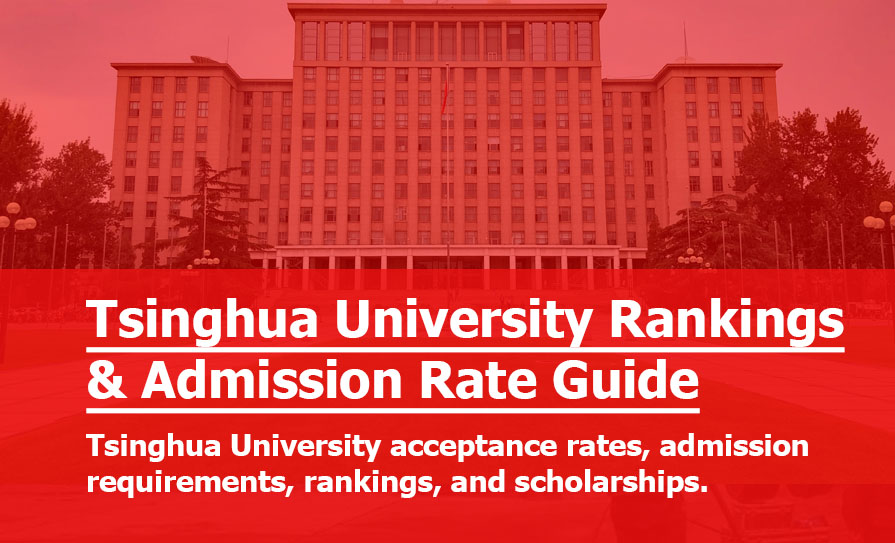
Tsinghua University Acceptance Rate and Admission Guide
If you want to study at Tsinghua University, you should prepare for one hard truth early: admission is extremely competitive. Tsinghua University is often called the “MIT of China” because of its powerful engineering programs, fierce academic standards, and global reputation in technology, business, science, architecture, and artificial intelligence. International students from across Asia, Africa, Europe, and North America compete for limited spaces every year. Recent estimates place Tsinghua University’s overall acceptance rate for international applicants somewhere between 3% and 8% depending on the program, applicant pool, and scholarship category. Highly competitive majors such as Computer Science, Engineering, Economics, and International Relations can be even more selective. That means strong grades alone may not save an application. You need academic depth, clear goals, language readiness, and a polished application strategy from the very beginning.
Over the last few years, Tsinghua University has continued climbing in global rankings while China’s higher education system expanded aggressively. According to QS World University Rankings and Times Higher Education Rankings, Tsinghua consistently ranks among the top universities in Asia and the world. Its rise has changed how international students view China. Ten years ago, many students focused mainly on the United States or the United Kingdom. Today, China stands firmly in that conversation. Tuition remains lower than many Western universities, yet research output, laboratory funding, and graduate employability continue rising. According to data from UNESCO Institute for Statistics and China’s Ministry of Education, international enrollment in Chinese universities grew steadily before the pandemic years and rebounded afterward as borders reopened and scholarship programs expanded.
For undergraduate applicants, Tsinghua University looks closely at academic performance, national exam results, extracurricular achievements, recommendation letters, personal statements, and English or Chinese language proficiency. Some departments may request interviews or additional testing. Postgraduate applicants face another layer of scrutiny because research alignment matters heavily. Professors want students whose research interests match ongoing departmental work. That means a graduate application is not simply about GPA. It becomes a story about intellectual direction, research potential, and academic maturity. Many rejected applicants actually have excellent grades. What separates admitted students is usually clarity, preparation, and fit.
International students also need to understand that admission standards have shifted in recent years. Before 2020, some programs accepted a broader international pool because universities wanted rapid global expansion. Since then, competition has tightened. Scholarship funding became more selective. English-taught programs gained popularity. Meanwhile, Chinese universities improved their global visibility through research partnerships, technology innovation, and stronger employer recognition. As a result, Tsinghua’s applicant pool today is far stronger than it was five or six years ago. Students applying in 2026 are competing against applicants with research internships, Olympiad achievements, startup experience, published papers, and near-perfect academic records.
Still, difficult does not mean impossible. Every admission season, students from Nigeria, India, Pakistan, Indonesia, Kenya, Ghana, the United States, and many other countries receive offers from Tsinghua University. Some arrive with scholarships covering tuition and living costs. Others gain admission through exceptional essays, research portfolios, or leadership experiences that distinguish them from thousands of similar applicants. The road is narrow, but it is real. If you understand the acceptance rate, GPA expectations, SAT and IELTS requirements, scholarship systems, and admission strategy early enough, you give yourself a fighting chance before the race even begins.
Quick Overview of Tsinghua University
| Category | Details |
|---|---|
| University Name | Tsinghua University |
| Location | Beijing, China |
| Founded | 1911 |
| Type | Public Research University |
| Global Ranking | Top 30 globally in many rankings |
| Estimated Acceptance Rate | 3%–8% |
| Popular Programs | Engineering, Computer Science, Business, AI |
| Main Language | Chinese and English |
| IELTS Requirement | Usually 6.0–7.0 |
| Scholarships Available | Yes |
| International Student Friendly | Very Strong |
Tsinghua University Rankings and Global Reputation
Tsinghua University’s reputation did not appear overnight. The institution was founded in 1911 during a turbulent moment in Chinese history, and over more than a century it transformed into one of Asia’s strongest academic powerhouses. Today, the university stands shoulder to shoulder with elite institutions across the globe. In many ranking systems, Tsinghua competes directly with universities like Massachusetts Institute of Technology, Stanford University, and University of Oxford in engineering, technology, and applied sciences. Rankings alone never tell the full story, yet they reveal how dramatically China’s education system has evolved over the past two decades.
According to QS World University Rankings, Tsinghua has repeatedly ranked among the top universities globally and frequently among the top universities in Asia. In engineering and computer science subjects, the university often performs even better than its overall ranking suggests. Meanwhile, Times Higher Education Rankings consistently places Tsinghua near the top for research impact, industry income, and citation influence. Those rankings matter because employers, scholarship bodies, and immigration authorities often recognize them when evaluating graduates. A degree from Tsinghua carries growing international weight, particularly in technology and engineering sectors.
One reason for this rise is research investment. China has poured enormous funding into higher education through national initiatives such as Project 985 and the Double First-Class University Plan. Tsinghua became one of the primary beneficiaries of those investments. Massive laboratories, advanced research centers, AI institutes, and international collaborations expanded rapidly during the last decade. This growth changed the academic atmosphere on campus. Students no longer study only from textbooks. Many participate directly in robotics research, renewable energy projects, biomedical innovation, and machine learning development. That environment attracts ambitious students from around the world.
The university’s alumni network also strengthens its reputation. Tsinghua graduates include influential engineers, business executives, politicians, scientists, and entrepreneurs. In China especially, the institution holds extraordinary prestige. Some people compare its social standing to the Ivy League in the United States. Graduating from Tsinghua can open doors in multinational companies, research institutes, technology firms, and government organizations. Employers understand the difficulty of admission and the rigor of the academic environment. That recognition often translates into strong graduate employment outcomes both inside and outside China.
Another important shift happened after 2020. Global attention toward Chinese technology and innovation increased sharply. Fields like artificial intelligence, semiconductor research, renewable energy, and advanced manufacturing pushed universities like Tsinghua into international headlines. More students who once looked only at the US or UK began considering China seriously. Tuition costs in Western countries also climbed dramatically. Compared with many American universities charging over $50,000 annually, Tsinghua’s tuition and living expenses can appear far more affordable. That balance between prestige and cost explains why international applications continue rising each year.
Tsinghua University Acceptance Rate for International Students
The acceptance rate at Tsinghua University is extremely low, especially for international students applying to competitive programs. While the university does not publicly publish one fixed overall acceptance rate for every department, many educational analysts and admission experts estimate the international acceptance rate falls between 3% and 8%. Some graduate departments may admit even fewer applicants. Programs tied to artificial intelligence, computer science, economics, finance, and engineering often receive thousands of applications from top-performing students across the world. In practical terms, that means Tsinghua rejects far more applicants than it admits.
Acceptance rates also vary by academic level. Undergraduate admission tends to focus heavily on academic excellence, standardized results, extracurricular distinction, and language readiness. Postgraduate admissions become even more selective because faculty supervisors directly evaluate research potential. A master’s or PhD application may succeed only if a professor believes your academic interests align with departmental priorities. This makes graduate admissions unpredictable. Two students with similar GPAs may receive completely different outcomes depending on research fit, publications, recommendation letters, and interview performance.
Competition has intensified compared with previous years. Before the pandemic, some international programs accepted broader student pools because universities across Asia were expanding aggressively. However, after 2021, application numbers rose sharply while many universities tightened quality control. Students from highly competitive educational systems now apply in greater numbers. Applicants increasingly arrive with international Olympiad medals, published research, coding portfolios, startup experience, and near-perfect grades. In other words, the average admitted student profile today is much stronger than it was five or six years ago.
Another factor affecting acceptance rates is scholarship competition. Many international students do not merely apply for admission. They apply for fully funded scholarships simultaneously. That creates a second level of selectivity. Some students may technically qualify academically but fail to receive funding because scholarship committees prioritize leadership, research promise, or national strategic partnerships. Scholarships like the Chinese Government Scholarship and Beijing Government Scholarship attract enormous interest every year. The number of applicants often far exceeds available awards.
Still, applicants should not become discouraged by the low acceptance rate alone. Universities do not admit statistics. They admit people. Strong essays, authentic motivation, research alignment, and clear career direction can significantly improve an application. Admissions officers often recognize when a student understands why Tsinghua specifically fits their academic goals. Generic applications disappear into the crowd quickly. Focused applications stand out. The process resembles climbing a steep mountain path in fog. Difficult, yes. Impossible, no.
Tsinghua University Undergraduate Admission Requirements
Undergraduate admission at Tsinghua University demands much more than good grades. The university wants students who demonstrate intellectual strength, discipline, leadership, curiosity, and long-term academic promise. International applicants usually submit secondary school transcripts, graduation certificates, recommendation letters, a personal statement, proof of language proficiency, and passport documents. Depending on the program, applicants may also need SAT, ACT, A-Level, IB, or national examination results. Some departments conduct interviews as part of the evaluation process.
Academic excellence remains the foundation of admission. Most successful applicants rank near the top of their graduating classes. Students taking A-Levels often present multiple A or A* grades. IB students frequently score above 38 or 40 points. Applicants from American curricula generally possess strong GPAs combined with advanced coursework like AP classes. Nigerian applicants with WAEC or NECO results usually need exceptional distinctions across core subjects. Tsinghua evaluates educational context carefully, but weak academic performance rarely survives the screening process.
Personal statements matter more than many students realize. Admissions officers read thousands of applications from academically talented candidates. Essays help separate students who merely want prestige from students who possess authentic academic direction. A strong statement explains why you chose your program, why Tsinghua fits your goals, and how your experiences shaped your ambitions. Generic writing damages applications quickly. Students who simply say “I want to study in China because it is developed” often fail to create meaningful impact. Specificity matters.
Extracurricular activities can also strengthen undergraduate applications significantly. Leadership roles, science competitions, coding projects, debate clubs, volunteer work, entrepreneurship, research internships, or artistic achievements help demonstrate initiative and character. Tsinghua values students who contribute beyond classroom performance. However, admissions officers usually prefer depth over quantity. A student deeply committed to one meaningful project often appears stronger than another student listing twenty shallow activities without measurable impact.
Language proficiency requirements depend on the language of instruction. English-taught programs usually require IELTS or TOEFL scores, while Chinese-taught programs require HSK certification. Some departments may waive English testing if previous education occurred fully in English, though policies vary. Competitive applicants often exceed minimum score requirements rather than merely meeting them. Strong language ability reassures admissions officers that students can survive academically inside a demanding university environment.
GPA Requirements for Undergraduate and Postgraduate Applicants
Tsinghua University does not always publish one universal GPA cutoff because academic systems differ globally. Nevertheless, competitive applicants generally possess extremely strong academic records. For undergraduate applicants, this often translates into grades equivalent to an A average or higher. For postgraduate applicants, competitive GPAs usually fall around 3.5 to 3.9 on a 4.0 scale. Some departments, especially in engineering or business, may expect even stronger academic performance due to the intensity of competition.
Undergraduate GPA expectations vary depending on curriculum type. Students from British-patterned systems are usually evaluated through A-Level results or equivalent examinations. American curriculum students are evaluated through GPA, AP coursework, and standardized testing. IB students are assessed holistically through predicted and final scores. Admissions committees look beyond raw numbers alone. They also consider course rigor. A slightly lower GPA earned in extremely challenging courses may appear stronger than perfect grades in easier subjects.
Graduate admissions place even heavier emphasis on academic consistency. Professors want students capable of handling advanced research and intensive coursework. Weak grades in major-related subjects can raise concerns quickly. For example, an engineering applicant with low mathematics grades may struggle to convince evaluators of academic readiness. Research experience can sometimes compensate partially, but poor academic fundamentals remain difficult to overcome in highly technical programs.
Comparing previous years reveals that GPA expectations have become more demanding over time. As international applications increased, departments gained greater freedom to select only the strongest candidates. Before 2018, some programs admitted students with moderately strong records if other areas of the application stood out significantly. Today, because the applicant pool has strengthened globally, strong GPAs function almost like an entry ticket rather than a competitive advantage. Many rejected applicants already possess excellent grades.
Students should also understand that GPA alone never guarantees admission. Some applicants become obsessed with numerical perfection while neglecting essays, recommendations, or research fit. Admissions committees evaluate the full picture. A student with a slightly lower GPA but extraordinary research potential or leadership experience may outperform another applicant with near-perfect grades but weak direction. Universities build communities, not spreadsheets. Tsinghua especially values evidence of intellectual seriousness and long-term ambition.
SAT and ACT Requirements for Tsinghua University
Tsinghua University does not always require SAT or ACT scores for every international applicant, but strong standardized test results can significantly strengthen an undergraduate application, especially for applicants from American-style educational systems. Competitive applicants often submit SAT scores above 1450 or ACT scores above 32. In elite programs like computer science, engineering, or economics, admitted students may present even higher scores. These exams help admissions officers compare students across different educational backgrounds.
The role of standardized testing has evolved in recent years. Around 2020 and 2021, many universities globally became test-optional because of pandemic disruptions. However, strong SAT or ACT scores still carry value in highly selective admissions environments. Tsinghua admissions officers understand that grading systems vary widely between countries and schools. Standardized exams provide an additional benchmark. Students from less familiar educational systems sometimes benefit greatly from presenting strong test scores because they offer measurable international comparison.
High math scores matter particularly for STEM-related programs. Engineering and computer science departments expect strong quantitative reasoning ability. Students applying to humanities or social science programs may still need competitive overall scores, but admissions officers may focus more heavily on reading, writing, and analytical strengths. Even so, balanced performance generally creates a stronger impression than uneven testing profiles.
Students should avoid assuming that test scores alone can compensate for weak academic records. Tsinghua admissions remain holistic. Excellent SAT or ACT results help confirm academic readiness, yet they rarely erase poor grades, weak essays, or unclear goals. Likewise, some students with slightly lower standardized scores still gain admission because of outstanding extracurricular achievements, research experience, or exceptional personal statements. Context matters deeply.
Comparisons with previous years show rising score competitiveness among international applicants. As more high-achieving students apply globally, average admitted profiles continue strengthening. Ten years ago, an SAT score around 1350 might have appeared highly competitive internationally. Today, in elite global admissions landscapes, many applicants exceed 1500. This reflects broader global academic competition rather than changes unique to Tsinghua alone. Students aiming for admission should therefore treat standardized tests as one important pillar within a much larger application strategy.
IELTS and English Proficiency Requirements
English proficiency requirements at Tsinghua University depend largely on the language of instruction. For English-taught programs, international students usually need IELTS, TOEFL, or equivalent English language certification. Most undergraduate and postgraduate English-medium programs expect IELTS scores around 6.0 to 7.0. Competitive departments sometimes prefer higher results, especially for graduate-level study where research writing and academic communication become more demanding.
Students often misunderstand the difference between minimum scores and competitive scores. Meeting the minimum requirement does not automatically make an applicant strong. In highly selective programs, many successful applicants exceed official minimum thresholds comfortably. For example, if a department requires IELTS 6.5, admitted students may commonly present 7.0 or 7.5. Strong English proficiency reassures admissions committees that students can survive lectures, presentations, academic writing, and collaborative research environments without severe language barriers.
TOEFL requirements usually range between 80 and 100 depending on the department. Some graduate programs may request even higher scores. Applicants educated entirely in English-medium institutions may sometimes receive waivers, though policies vary across departments and years. Students should always verify current requirements directly through official program pages because universities occasionally revise language policies during admission cycles.
Chinese-taught programs require HSK certification instead of IELTS in many cases. Some undergraduate programs demand HSK Level 5 or Level 6 because students must understand lectures, complete assignments, and participate academically in Mandarin. International students often underestimate how challenging academic Chinese can become. Everyday conversational fluency differs greatly from technical academic comprehension. Applicants considering Chinese-medium study should begin preparation early rather than rushing language learning months before deadlines.
English proficiency expectations have become stricter over time because classrooms are increasingly international and academically intensive. Universities want students capable of contributing effectively from the beginning of their studies. Weak language ability can damage classroom performance, social integration, and research productivity. Strong communication skills therefore function not merely as administrative requirements but as survival tools inside demanding academic environments.
Scholarships Available at Tsinghua University
Scholarships remain one of the biggest reasons international students consider Tsinghua University seriously. Compared with tuition costs in the United States, Canada, or the United Kingdom, Chinese scholarship systems can appear remarkably generous. Tsinghua participates in several major funding schemes, including the Chinese Government Scholarship, Beijing Government Scholarship, Confucius Institute Scholarship, and university-specific awards. Some scholarships cover full tuition, accommodation, monthly stipends, and medical insurance.
The Chinese Government Scholarship remains one of the most competitive and prestigious options. Funded by the Chinese Scholarship Council, this program supports thousands of international students across China each year. At Tsinghua, competition for these awards is intense because applicants worldwide recognize the university’s prestige. Scholarship committees evaluate academic excellence, leadership potential, language ability, research interests, and overall application quality. Strong grades alone rarely guarantee funding.
Tsinghua also offers university-level scholarships for outstanding students. Some awards target undergraduate applicants while others support master’s and PhD candidates. Research-focused scholarships may prioritize students whose work aligns with strategic scientific or technological priorities. In recent years, China increased investment in research areas like artificial intelligence, renewable energy, public health, and advanced manufacturing. Applicants connected to these fields sometimes benefit from broader funding opportunities.
International students should prepare scholarship applications carefully because deadlines often arrive earlier than expected. Recommendation letters, study plans, research proposals, and language certifications must usually be submitted together. Weakly prepared scholarship applications fail quickly even when the student appears academically qualified. Scholarship committees want evidence that applicants understand their academic goals clearly and possess the discipline to complete demanding programs successfully.
Scholarship competition has intensified sharply compared with previous years. Rising tuition costs globally pushed more students toward funded study options abroad. At the same time, Tsinghua’s international reputation expanded dramatically. As a result, scholarship acceptance rates became far lower than ordinary admission rates in some programs. Students who approach scholarship applications casually often underestimate the seriousness of the process. Preparation, clarity, and timing matter enormously.
How to Get Admitted Into Tsinghua University
Getting admitted into Tsinghua University requires strategy, preparation, and realism. The first step is understanding the level of competition honestly. Many students apply with generic applications copied across multiple universities. Tsinghua’s admissions process rewards specificity. You must show why this university fits your goals better than alternatives elsewhere. That means researching departments carefully, understanding faculty strengths, and connecting your interests directly to available academic opportunities.
Academic preparation should begin early. Strong grades developed consistently over several years matter more than last-minute improvement. Competitive applicants often challenge themselves with advanced coursework, Olympiads, research projects, or independent academic initiatives. Students interested in engineering or science should strengthen mathematics rigor aggressively. Humanities applicants should focus on writing, analysis, debate, and communication abilities. Universities look for evidence of intellectual seriousness long before application deadlines arrive.
Application essays deserve enormous attention. Weak essays quietly destroy many otherwise strong applications. Admissions officers can easily recognize vague writing filled with clichés. Strong essays feel personal, specific, and intellectually grounded. Instead of saying “I want to study at Tsinghua because it is prestigious,” explain the research areas, academic programs, professors, or experiences that genuinely connect with your ambitions. Clear purpose creates memorable applications.
Recommendation letters also matter significantly. Strong recommendations come from teachers or supervisors who know you deeply and can discuss your abilities with concrete examples. Generic praise like “hardworking student” carries little weight. Effective letters describe intellectual curiosity, leadership, resilience, creativity, or research potential through real experiences. Students should build meaningful relationships with mentors early instead of scrambling for recommendation letters weeks before deadlines.
Finally, successful applicants usually understand that admission is partly a game of positioning. You cannot control every outcome, but you can strengthen your odds systematically. Research programs thoroughly. Prepare standardized tests early. Improve language proficiency steadily. Build meaningful extracurricular experiences. Write authentic essays. Seek strong mentorship. Apply strategically. The process resembles building a bridge stone by stone across a wide river. No single stone guarantees success. Together, however, they create a path forward.
Final Thoughts on Tsinghua University Admission
Tsinghua University stands today as one of the most competitive universities in the world for international students. Its low acceptance rate reflects more than prestige alone. It reflects rising global competition, stronger applicant pools, expanding research influence, and China’s growing role in international higher education. Students applying in 2026 face a far more demanding admissions landscape than applicants did a decade ago. Yet opportunity still exists for students who prepare carefully and apply strategically.
The university rewards academic excellence, intellectual ambition, and clarity of purpose. Whether you are applying for undergraduate study in engineering or postgraduate research in artificial intelligence, your application must tell a coherent story. Strong GPA scores, IELTS results, SAT performance, extracurricular achievements, research experience, and recommendation letters all matter. Still, the students who often stand out most are those who understand exactly why they belong there.
For many international students, Tsinghua represents more than a university. It represents entry into one of the fastest-changing academic and technological environments in the world. China’s research ecosystem continues expanding rapidly, and graduates from elite institutions increasingly compete globally in technology, science, finance, diplomacy, and entrepreneurship. That momentum explains why applications continue rising every year despite fierce competition.
If you plan to apply, start early. Research program requirements deeply. Study previous admission trends. Build strong academic habits now instead of later. Strengthen your language skills steadily. Prepare scholarship applications carefully. Most importantly, approach the process with realism and patience. Elite admissions rarely reward rushed preparation.
The old saying remains true: difficult roads often lead to remarkable destinations. Tsinghua University is one of those roads.