If you are a young researcher looking to gain international experience in cancer research, the AIRC Short-Term Fellowships 2026 offer a unique fully funded opportunity to train at top laboratories and hospitals across the world.
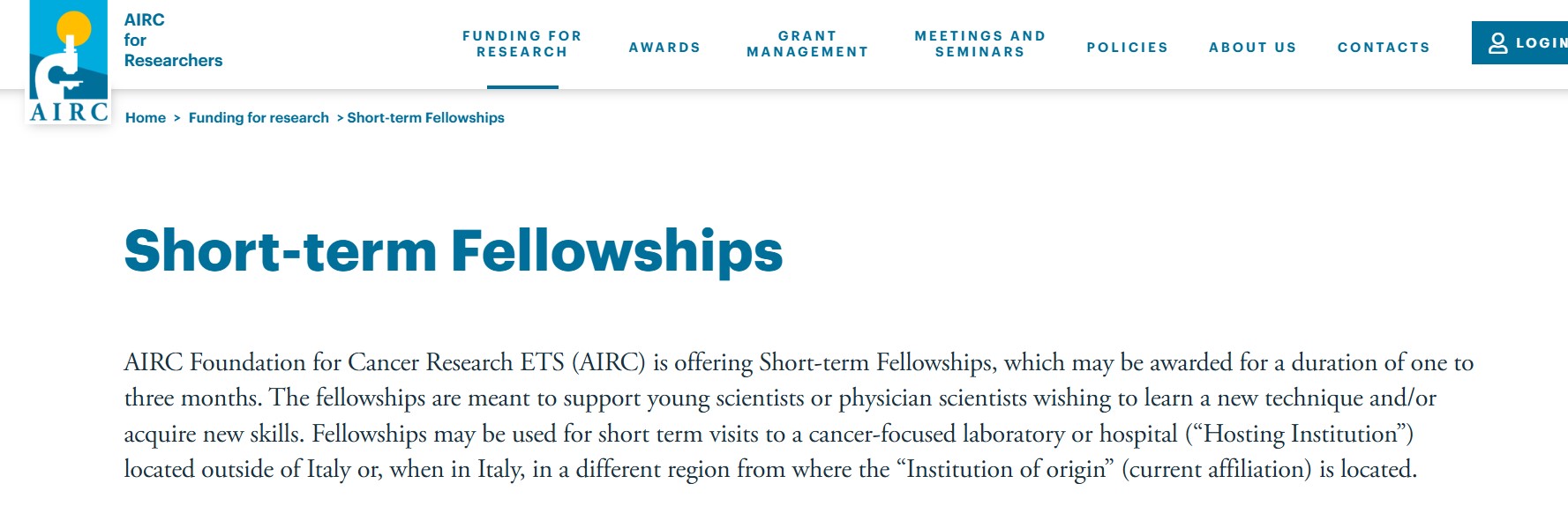
Funded by the Fondazione AIRC per la Ricerca sul Cancro, this fellowship is designed to support early-career scientists who want to learn new techniques, improve their research skills, and collaborate with leading experts in oncology.
The next major deadline is May 29, 2026, making this one of the best fully funded fellowships still open in May 2026.
Fellowship Summary Table
| Category | Details |
|---|---|
| Host Organization | Fondazione AIRC per la Ricerca sul Cancro |
| Program Name | AIRC Short-Term Fellowships |
| Deadline | May 29, 2026 |
| Duration | 1 to 3 months |
| Funding Type | Fully funded (mobility support) |
| Field | Cancer Research / Biomedical Sciences |
| Eligible Level | PhD students, Postdocs, Medical Researchers |
| Study Location | Italy or International research labs |
About the AIRC Short-Term Fellowship
The AIRC Short-Term Fellowship is a research mobility program that allows scientists to spend 1 to 3 months in a different laboratory or hospital to gain advanced skills in cancer research.
The fellowship focuses on:
- Learning new laboratory techniques
- Building international research collaborations
- Enhancing career development in oncology
Participants can conduct research either:
- Abroad (outside Italy), or
- In a different region within Italy
Funding Benefits
Although it is a short-term fellowship, AIRC provides strong financial support, making it effectively fully funded.
Benefits include:
- Travel expenses (flight or transport)
- Accommodation costs
- Health insurance (if required)
- Mobility allowance for research stay
💡 In some cases, fellows may receive monthly support (around €1,500) depending on the project and duration.
Fellowship Duration
- Minimum: 1 month
- Maximum: 3 months
This makes it ideal for:
- Short research visits
- Skill acquisition programs
- Collaborative scientific projects
AIRC Fellowship 2026 Deadline
The AIRC fellowship has multiple deadlines based on start date:
- February 6, 2026 → For May–August 2026 visits
- May 29, 2026 → For September–December 2026 visits
- September 30, 2026 → For early 2027 visits
The May 29, 2026 deadline is currently the most relevant and open.
Eligibility Criteria
To apply for the AIRC Short-Term Fellowship, applicants must meet the following:
- Be a young researcher or physician-scientist
- Be involved in cancer research or biomedical sciences
- Hold or be enrolled in:
- PhD program OR
- Medical specialization program
- Typically under 40 years old (varies by call)
- Must have:
- A host institution/lab agreement
- A clear research plan
Who Should NOT Apply
Applications may be rejected if:
- You already have a permanent research position
- You are applying to a lab where you previously worked
- Your research visit has already started
- The location is within daily commuting distance
- You are a previous recipient of this fellowship
Required Documents
Applicants must prepare:
- Research proposal (cancer-related project)
- Letter of acceptance from host institution
- Budget justification
- Academic CV
- Institutional approvals
Available Research Locations
Fellows can work in top institutions worldwide, including:
- Universities in Europe (UK, Germany, Netherlands)
- Research hospitals in the USA
- Cancer research centers in Italy
Examples of past host institutions include:
- University College London
- Columbia University Medical Center
- University of Cologne
How to Apply (Step-by-Step)
- Find a host laboratory or hospital
- Develop a cancer-related research proposal
- Get approval from both:
- Home institution
- Host institution
- Prepare required documents
- Submit application via the AIRC portal
👉 Apply here:
🔗 https://www.direzionescientifica.airc.it/funding-for-research/other-funding-opportunities/
Why You Should Apply
- Fully funded international research exposure
- Short duration (easy to fit into academic schedule)
- Boosts your CV for:
- PhD
- Postdoc
- Global fellowships
- Opportunity to work with top cancer research experts
FAQs
Is the AIRC Short-Term Fellowship truly fully funded?
Yes, the fellowship is considered fully funded for short-term research mobility, but it’s important to understand what that means in practice.
AIRC typically covers:
- International or local travel costs (flights/train)
- Accommodation expenses during your stay
- A mobility allowance to support daily living
- In some cases, health insurance
However, unlike long-term scholarships, this is not a salary-based program. The funding is meant to support your research visit, not replace a full monthly income.
Who is eligible to apply for this fellowship?
The AIRC fellowship is targeted at early-career researchers in cancer research or related biomedical fields.
You are eligible if you:
- Are a PhD student, postdoctoral researcher, or medical doctor in training
- Are actively working on a cancer-related research project
- Have an academic or research institution affiliation
- Secure a host lab or institution before applying
Do I need IELTS or proof of English proficiency?
No, IELTS is not required for this fellowship.
However:
- You must be able to communicate effectively in English
- Some host institutions may informally assess your language ability
If your host lab operates in:
- Italy → English is usually acceptable
- Other countries → English proficiency may still be expected
What kind of research projects are accepted?
AIRC strictly funds cancer-related research, including:
- Oncology (tumor biology, cancer genetics)
- Clinical cancer studies
- Drug development and therapies
- Cancer prevention and diagnostics
Not accepted:
- General biology without cancer focus
- Unrelated medical fields
Your proposal must clearly show how your work contributes to cancer research.
How competitive is the AIRC Short-Term Fellowship?
The fellowship is moderately competitive, but less intense than long-term global fellowships.
Selection is based on:
- Quality of your research proposal
- Strength of your academic CV
- Reputation of the host institution
- Relevance to cancer research goals
To stand out:
- Propose a clear, practical research plan
- Choose a strong host lab
- Show how the fellowship will advance your career
CHECK THESE OUT:
Chevening LSE Fellowship 2026 in the UK (Fully Funded)
2026 New York Times Fellowship Program | Fully Paid Journalism Fellowship
Einstein Fellowship 2027 in Germany (Fully Funded)
European Youth Summit 2026 — Fully Funded Short-Term Exchange for Students & Young Leaders