
Are you an early-career researcher with an innovative idea that could help solve pressing societal challenges? The Open Call for Constructive Advanced Thinking (CAT) Programme 2027-2029 offers a unique opportunity to collaborate with interdisciplinary research teams across Europe through a partially funded fellowship programme.
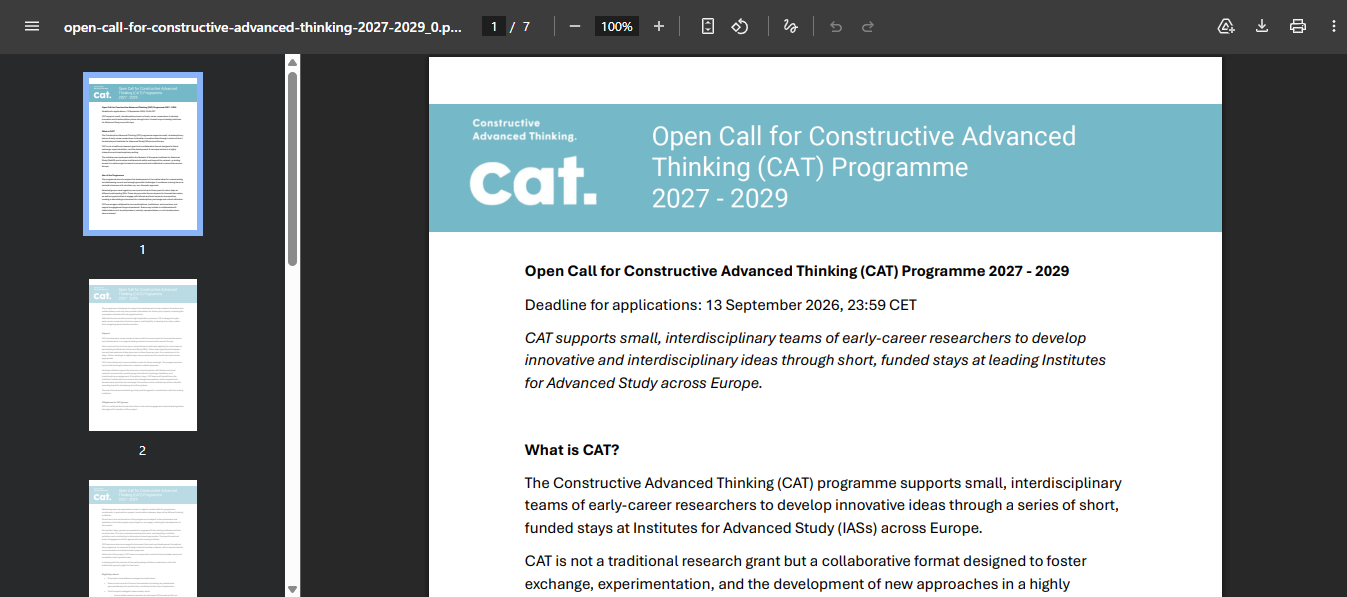
Open Call for Constructive Advanced Thinking (CAT) Programme
Unlike traditional research grants, the CAT Programme focuses on providing researchers with time, space, and opportunities to develop groundbreaking ideas through a series of funded research stays at leading Institutes for Advanced Study (IASs) across Europe. The programme covers travel and accommodation expenses but does not provide salaries or research funding, making it a partially funded fellowship.
The initiative is organized by the Network of European Institutes for Advanced Study (NetIAS) and participating partner institutes to promote interdisciplinary collaboration, innovation, and research with real societal impact.
Open Call for Constructive Advanced Thinking (CAT) Programme 2027-2029 Summary
| Category | Details |
| Host Region | Europe |
| Programme Name | Constructive Advanced Thinking (CAT) Programme 2027–2029 |
| Programme Type | Early-Career Research Fellowship |
| Funded By | Network of European Institutes for Advanced Study (NetIAS) and Participating Institutes |
| Eligible Applicants | Early-Career Researchers in Europe (including EU, UK, and Associated Countries) |
| Funding Type | Partially Funded |
| Financial Coverage | Travel and Accommodation Costs for Research Stays |
| Project Duration | Up to 3 Years (2027-2029) |
| Number of Team Members | 3-5 Researchers |
| Application Deadline | 13 September 2026 |
| Programme Period | January 2027 – December 2029 |
What Is the CAT Programme All About?
The Constructive Advanced Thinking (CAT) Programme is a collaborative fellowship initiative that supports small teams of early-career researchers working on innovative ideas that address current and emerging societal challenges.
Rather than funding laboratory research or salaries, CAT provides researchers with opportunities to meet regularly in inspiring academic environments across Europe. These short research residencies encourage creative thinking, interdisciplinary discussions, and collaboration among scholars from different countries and academic backgrounds.
The programme follows a bottom-up approach, meaning there are no predefined research themes. Instead, applicants are encouraged to develop original ideas with strong academic quality and clear societal relevance.
Selected teams will meet several times over three years at different participating Institutes for Advanced Study, where they will interact with resident fellows, leading academics, and local research communities.
Is the CAT program fully funded or partially funded?
The Constructive Advanced Thinking (CAT) Programme is a partially funded fellowship.
The programme covers:
- Travel expenses for approved research stays.
- Accommodation during visits to participating institutes.
- Access to leading European research environments.
- Opportunities to collaborate with renowned scholars.
- Intellectual support from hosting institutes.
- Networking with international researchers.
However, CAT does not provide:
- Salaries.
- Research grants.
- Laboratory costs.
- Equipment funding.
- Personal research expenses.
Who Can Apply? (Eligibility Criteria)
Applicants must satisfy all of the following eligibility requirements:
- The proposed project must focus on an emerging societal issue.
- Teams must consist of three to five members.
- The team must be fully formed before submitting the application.
- The Principal Investigator (Team Leader) must:
- Hold a stable research position at a European higher education or research institution throughout the project.
- Have obtained a PhD between January 2017 and September 2026.
- Other team members:
- Must not have obtained their PhD before January 2017.
- Doctoral researchers may also participate.
- Team members must represent at least two different countries based on institutional affiliation.
- Researchers affiliated with institutions outside Europe may participate if their involvement strengthens the project.
- Extensions beyond the PhD eligibility window may be considered for documented career interruptions, such as:
- Parental leave
- Long-term illness
- National service
- Clinical training
- Natural disasters
- Seeking asylum
There are no age restrictions or formal qualification requirements for stakeholder representatives participating in the project.
Programme Benefits
Although CAT is not a traditional research grant, selected teams receive substantial support throughout the programme, including:
- Full travel funding for approved meetings.
- Accommodation during each research stay.
- Access to Europe’s leading Institutes for Advanced Study.
- Opportunities to engage with international research communities.
- Interdisciplinary collaboration across institutions and countries.
- Academic networking and mentoring.
- Time and space to develop innovative research ideas.
- Opportunities to build long-term international collaborations.
- Strong foundation for future research funding applications.
Research Themes
The CAT Programme does not impose strict thematic limitations. Instead, proposals should address important societal challenges while demonstrating interdisciplinary collaboration.
Projects may involve areas such as:
- Artificial Intelligence
- Climate Change
- Public Health
- Democracy and Governance
- Digital Society
- Migration
- Sustainability
- Social Justice
- Education
- Economics
- Humanities
- Technology
- Ethics
- Environmental Policy
- Public Policy
- Cultural Studies
Applicants are also encouraged to collaborate with policymakers, industry partners, civil society organizations, or other stakeholders where appropriate.
Required Application Documents
Applications must be submitted in English as PDF files and include:
- A 300-word project abstract.
- A project proposal (maximum 3,000 words).
- Alternatively, a video presentation (maximum 15 minutes) with a link included in the abstract.
- A detailed work plan covering:
- Planned meetings.
- Tentative schedule.
- Preferred hosting institutes.
- Timeline of activities.
- Short description of the research team.
- CVs for all participants (maximum three pages each).
- Two academic letters of support.
- Additional letters from non-academic stakeholders (optional but encouraged).
Incomplete applications will not be considered.
Selection Criteria
Applications will be evaluated based on:
- Academic excellence.
- Originality of the proposed idea.
- Interdisciplinary approach.
- Relevance to current and emerging societal challenges.
- Strength and diversity of the research team.
- Feasibility of the proposed work plan.
- Potential for long-term collaboration.
Applications undergo an internal review followed by assessment from external experts before final decisions are made.
Step-by-Step Application Process
Follow these steps to apply for the CAT Programme 2027–2029:
Step 1: Form Your Research Team
Assemble a team of three to five eligible members from at least two different countries.
Step 2: Develop Your Research Proposal
Prepare a proposal that clearly explains:
- Research question
- Innovative approach
- Societal relevance
- Interdisciplinary collaboration
- Work plan
Step 3: Gather Supporting Documents
Prepare:
- CVs
- Letters of support
- Project abstract
- Timeline
- Work plan
Step 4: Submit Your Application
Email your completed application as PDF files to the program coordinator before the deadline.
Step 5: Wait for Evaluation
Applications undergo internal and external review before final selections are announced.
Successful applicants will be notified by the end of December 2026.
Important Dates
| Event | Date |
| Application Opens | Currently Open |
| Zoom Information Session | 24 August 2026 |
| Application Deadline | 13 September 2026 (23:59 CET) |
| Notification of Results | End of December 2026 |
| Programme Begins | January 2027 |
| Programme Ends | December 2029 |
Why Apply for the CAT Programme?
The Constructive Advanced Thinking (CAT) Programme offers far more than financial assistance. It provides early-career researchers with an exceptional opportunity to collaborate across disciplines, institutions, and countries while developing innovative ideas that address real-world challenges.
Unlike conventional research grants, CAT prioritizes intellectual exchange, creativity, and interdisciplinary collaboration. Participants benefit from funded research stays at some of Europe’s leading Institutes for Advanced Study, allowing them to build lasting international partnerships, expand their academic networks, and lay the foundation for future research projects and external funding opportunities.
For researchers seeking to grow their careers while making meaningful contributions to society, the CAT Programme 2027–2029 is an outstanding opportunity.
For more information and to apply, visit the official programme website:
https://netias.science/sites/default/files/documents/2026-05/open-call-for-constructive-advanced-thinking-2027-2029_0.pdf
MORE RELATED CONTENT:
Claude Corps Fellowship 2026 (USA)
Spirit of Togetherness Award 2026 by Pernod Ricard
Chevening Southeast Europe British Library Fellowship 2026/2027
LEGO Foundation Fellowship 2026