
Notre Dame college football is not merely a competitive enterprise; it is a national myth woven from faith, grit, immigrant ambition, and a century of Saturdays that have echoed across the American Midwest and far beyond. Rooted in South Bend and representing the University of Notre Dame, the Fighting Irish emerged at a time when college football itself was still discovering its shape, its rules, and its cultural purpose. In the late nineteenth and early twentieth centuries, when the sport was rougher, less regulated, and regionally fragmented, Notre Dame carved out an identity defined by independence—both spiritual and competitive—establishing itself as a Catholic institution willing to travel anywhere and play anyone, an audacious strategy that built a national following long before television stitched the country together.
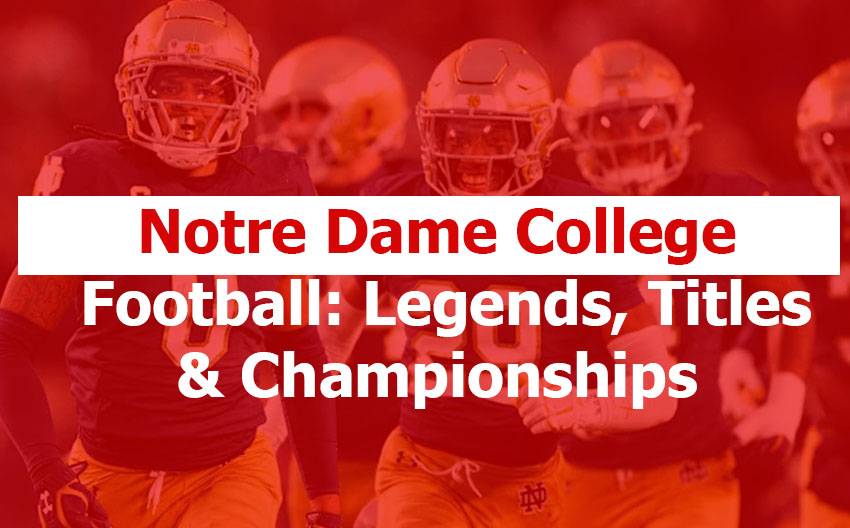
Notre Dame College Football: The Origins and Identity of Notre Dame College Football
The early decades of Notre Dame college football were shaped profoundly by Knute Rockne, whose name still resonates like a bell tolling through history. Rockne was more than a coach; he was a cultural architect who understood that storytelling, innovation, and charisma could elevate a program beyond regional relevance. Under his guidance, Notre Dame not only won games but redefined offensive football with the forward pass, popularizing strategic concepts that forced the sport to evolve. His teams’ success in the 1910s and 1920s turned Notre Dame college football into a national brand before branding was even a conscious pursuit, and the legend of Rockne remains inseparable from the identity of the Fighting Irish.
Central to this identity is Notre Dame Stadium, a venue whose austere architecture reflects the university’s blend of tradition and discipline. The stadium’s atmosphere is less theatrical than some modern arenas, yet it carries a gravity that feels almost ecclesiastical, as if the echoes of past champions linger in the autumn air. The golden helmets glint beneath Midwestern skies, and the rituals—from the team’s walk across campus to the singing of the alma mater—reinforce the idea that Notre Dame college football operates within a framework of heritage rather than spectacle alone.
Unlike many powerhouse programs, Notre Dame has historically maintained independence from major conferences, choosing instead to chart its own scheduling destiny. While it holds a partial affiliation with the Atlantic Coast Conference in other sports and scheduling agreements, its football independence has long been a strategic and philosophical statement. Competing at the highest tier within the NCAA Division I Football Bowl Subdivision, Notre Dame college football embraces a national schedule that reinforces its coast-to-coast identity, sustaining rivalries that span time zones and generations.
To understand Notre Dame college football is to recognize that its appeal extends beyond wins and losses. It is tied to questions of faith, immigration, resilience, and identity in American history. For much of the twentieth century, the program symbolized upward mobility for Catholic communities facing discrimination, and its victories were celebrated as communal triumphs. That symbolic weight remains embedded in the brand today, lending each season a resonance that transcends the scoreboard.
Championships and Dynastic Eras
The championship legacy of Notre Dame college football is vast and deeply interwoven with the evolution of the sport itself. The program claims multiple national championships across several eras, each reflecting a distinct stylistic and cultural moment in college football history. The Rockne era established early dominance, but the mid-twentieth century under coaches like Frank Leahy solidified Notre Dame’s reputation as a dynasty capable of sustained excellence. Leahy’s teams in the 1940s and early 1950s combined tactical precision with depth of talent, producing undefeated seasons that reinforced the Irish as a benchmark for national supremacy.
The 1960s and 1970s ushered in another golden age under Ara Parseghian and later Dan Devine, culminating in national championships that reaffirmed the program’s relevance in an increasingly competitive and televised era. These decades demonstrated Notre Dame college football’s adaptability, as the sport shifted toward more dynamic offenses and expanded media exposure. Parseghian’s calm leadership and Devine’s resilience ensured that the Fighting Irish remained at the forefront of national conversations.
The late 1980s brought yet another championship under Lou Holtz, whose 1988 team navigated a gauntlet schedule to claim the national title. Holtz’s tenure illustrated the enduring appeal of Notre Dame college football as both a competitive force and a moral narrative, blending discipline with ambition in a way that resonated with alumni and fans nationwide.
Featured Snippet Comparison Table:
| Era | Head Coach | National Titles | Signature Strength |
|---|---|---|---|
| 1918–1930 | Knute Rockne | Multiple | Forward-pass innovation |
| 1940s | Frank Leahy | Multiple | Undefeated dominance |
| 1960s–70s | Ara Parseghian | Multiple | Balanced execution |
| 1988 | Lou Holtz | 1 | Elite scheduling triumph |
These eras collectively reinforce a core truth: Notre Dame college football has repeatedly demonstrated an ability to regenerate excellence across generations, adapting to rule changes, scholarship limits, and media transformations without surrendering its competitive edge.
Rivalries That Shape the Irish Legacy
Few programs boast rivalries as nationally resonant as those of Notre Dame college football. The annual clash with University of Southern California stands as one of the sport’s most storied intersections of tradition and geography, a coast-to-coast duel that has produced iconic moments and Heisman-caliber performances. This rivalry underscores Notre Dame’s national identity, linking Midwest grit with West Coast flair in a contest that transcends conference affiliations.
Equally historic is the rivalry with University of Michigan, a Midwestern showdown rooted in early twentieth-century tensions and competitive pride. These matchups have often carried national championship implications, reinforcing the stakes and ensuring that each meeting becomes a chapter in a broader historical narrative.
The enduring annual series with United States Naval Academy adds a layer of respect and tradition, symbolizing shared values of discipline and honor. Notre Dame college football’s rivalries are not merely about animosity; they are about continuity, about shared history that stretches across decades and binds institutions together through competition.
Legendary Players and Heisman Heritage
The pantheon of Notre Dame college football includes multiple Heisman Trophy winners whose performances shaped the sport’s mythology. Paul Hornung, the “Golden Boy,” exemplified versatility and charisma in the 1950s, embodying the program’s blend of athleticism and national appeal. His success extended beyond college into professional acclaim, reinforcing Notre Dame’s developmental pedigree.
In 1977, Tim Brown electrified audiences with his speed and return ability, capturing the Heisman and solidifying the Irish as a pipeline for elite skill-position talent. Brown’s achievements reflected the program’s adaptability during a period when offensive dynamics were shifting toward greater explosiveness.
Featured Snippet Comparison Table:
| Player | Position | Heisman Year | Impact |
|---|---|---|---|
| Paul Hornung | HB | 1956 | Versatile scoring threat |
| Tim Brown | WR | 1987 | Dynamic return specialist |
These legends are not isolated icons but representatives of a developmental system that emphasizes discipline, academic rigor, and competitive excellence.
The Future of Notre Dame College Football
The modern era of Notre Dame college football unfolds within a rapidly evolving landscape defined by playoff expansion, NIL agreements, and conference realignment. While remaining independent in football, Notre Dame must navigate scheduling complexities and playoff criteria that increasingly reward conference championships. This strategic balancing act requires institutional foresight and adaptive leadership.
Recruiting now extends into digital branding and NIL collectives, reshaping how programs attract and retain elite athletes. Notre Dame’s academic standards and national brand remain powerful draws, yet the competitive marketplace demands innovation. Investments in facilities and analytics signal recognition that tradition alone cannot sustain dominance in a data-driven era.
Yet history offers reassurance. Notre Dame college football has endured world wars, integration challenges, media revolutions, and shifting governance structures, emerging each time with renewed purpose. The golden helmets still gleam, the stadium still fills, and the pursuit of excellence remains unwavering.
Notre Dame college football stands as a living chronicle of American sport—rooted in faith and fortitude, sustained by rivalry and reinvention, and forever chasing the next chapter in a saga more than a century in the making.