
Florida State University football occupies a rare space in college athletics where swagger meets substance, where flash is supported by foundation, and where sustained national relevance has shaped both institutional identity and statewide pride. The program representing Florida State University has grown from modest beginnings into one of the most recognizable brands in the sport. Official athletics records, schedules, and historical archives are maintained at https://seminoles.com, while verified championship documentation and statistical archives are available through the NCAA at https://www.ncaa.com. Florida State University football is not merely about wins and losses; it is about eras defined by dominance, resilience during transition, and an unwavering commitment to competing at the sport’s highest tier.
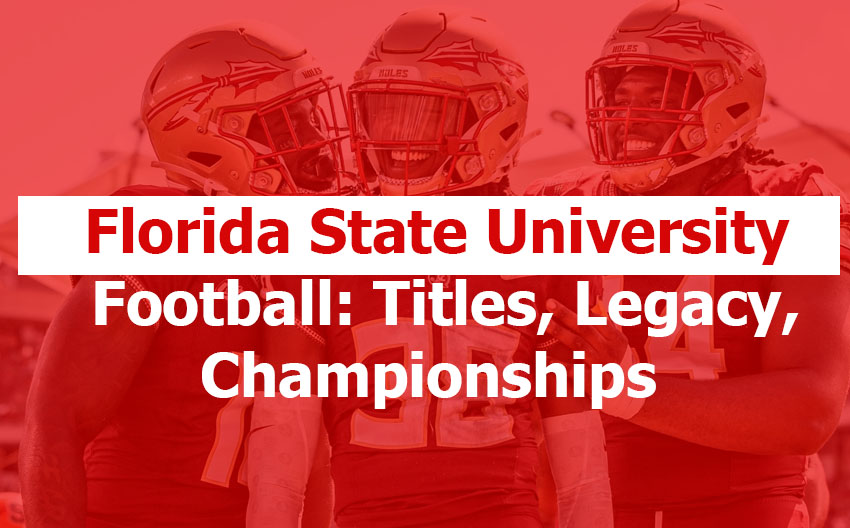
The Florida State Seminoles football have claimed national championships, produced Heisman Trophy winners, and established themselves as a perennial recruiting powerhouse in one of the most talent-rich regions in the country. Tallahassee sits within a state that breathes football year-round, and that proximity to elite high school programs has shaped the Seminoles’ recruiting DNA. Yet geography alone does not create champions. Structure, leadership, innovation, and cultural cohesion convert raw talent into trophies.
Throughout its evolution, Florida State has navigated conference realignments, coaching transitions, and shifts in offensive philosophy without surrendering its ambition. Expectations in Tallahassee are not aspirational; they are historical. Success is not a novelty but a benchmark measured against championship banners hanging in memory and record books. The program’s identity is inseparable from its golden stretches of dominance, yet equally shaped by its responses to adversity.
Florida State University football also stands as a cultural force. Game days transform Tallahassee into a convergence of tradition and spectacle, where the pageantry of college football blends with generational loyalty. The war chant reverberates, the marching band’s cadence echoes, and a sea of garnet and gold frames a stadium that has witnessed decades of triumph and heartbreak alike.
To understand Florida State football is to recognize that it has lived multiple lives within a single century—regional contender, national dynasty, rebuilding project, and resurging powerhouse. Its narrative arc reflects the cyclical nature of college football itself, where dominance must be continually re-earned, never assumed.
Foundations and the Rise Under Bobby Bowden
The early decades of Florida State football were defined by ambition more than accomplishment. Founded in the mid-20th century as a coeducational institution following its prior status as a women’s college, Florida State gradually expanded its athletic profile. Early teams competed with determination but lacked the structural advantages of more established football powers. Facilities were modest, recruiting pipelines were still forming, and the program sought a defining identity.
Everything changed with the arrival of Bobby Bowden in 1976. Bowden did not inherit a dynasty; he constructed one. His leadership philosophy blended personal mentorship with strategic aggression, emphasizing both faith-driven culture and fearless scheduling. In an era when many programs padded records with manageable opponents, Bowden scheduled national powers, believing that exposure and credibility required boldness.
Throughout the 1980s, Florida State surged into national relevance. The Seminoles became synonymous with speed and explosive playmaking, particularly on defense. Bowden cultivated a recruiting machine within Florida’s high school ecosystem, tapping into pipelines that would consistently deliver elite athletes. The program’s national ranking stabilized, and bowl appearances became routine rather than rare.
The 1990s solidified Florida State’s dynasty. From 1987 through 2000, the Seminoles finished in the AP Top 5 for 14 consecutive seasons, a record of sustained excellence unmatched in modern college football. National championships in 1993 and 1999 punctuated this era, elevating the program into permanent elite status. Bowden’s teams were balanced, opportunistic, and mentally resilient.
Bowden’s legacy extends beyond statistics. He institutionalized confidence. Florida State was no longer striving for legitimacy; it demanded it. His tenure redefined expectations and embedded championship culture into the university’s athletic identity.
National Championships and Heisman Glory
Florida State’s national championships in 1993 and 1999 represent apex moments in the program’s history. The 1993 team, led by Heisman Trophy-winning quarterback Charlie Ward, showcased a blend of offensive creativity and defensive speed that overwhelmed opponents. Ward’s dual-sport excellence—he also starred in basketball—added to the aura of that championship season.
The 1999 national championship team displayed overwhelming depth and defensive dominance. Anchored by future NFL talent, the Seminoles navigated an undefeated season that culminated in a decisive title victory. These championship squads reflected systematic excellence rather than isolated brilliance.
Heisman success returned in 2013 with Jameis Winston, whose electrifying freshman season powered Florida State to an undefeated record and a BCS National Championship victory. That 2013 team combined explosive offense with disciplined defense, finishing as one of the most efficient squads of the BCS era.
Florida State’s ability to produce elite quarterbacks highlights a broader institutional strength: player development. The program has repeatedly transformed highly rated recruits into nationally recognized leaders. This developmental consistency reinforces recruiting momentum and sustains brand prestige.
Championship seasons are crystallized in trophy cases, but they also influence perception for decades. Florida State’s titles serve as both historical anchors and aspirational benchmarks for future teams.
Comparison: Florida State National Titles
| Season | Head Coach | Record | Quarterback | Result |
|---|---|---|---|---|
| 1993 | Bobby Bowden | 12–1 | Charlie Ward | National Champion |
| 1999 | Bobby Bowden | 12–0 | Chris Weinke | National Champion |
| 2013 | Jimbo Fisher | 14–0 | Jameis Winston | National Champion |
Sources: NCAA Records (https://www.ncaa.com) and official athletics archives (https://seminoles.com)
Conference Identity and ACC Dominance
Florida State joined the Atlantic Coast Conference (ACC) in 1991, a move that reshaped the conference’s football hierarchy. Almost immediately, the Seminoles asserted dominance, winning multiple ACC championships and elevating the league’s national profile. Conference alignment details and historical standings are documented at https://theacc.com.
The ACC era allowed Florida State to combine regional recruiting strength with consistent national visibility. Competing annually against conference rivals provided structural stability, while non-conference scheduling maintained national exposure.
Dominance within the ACC reinforced the program’s championship identity. However, evolving conference dynamics and College Football Playoff expansion have introduced new strategic considerations. Strength of schedule, media contracts, and playoff access now influence institutional decision-making.
Florida State’s presence in the ACC remains significant, but broader realignment discussions illustrate the fluid nature of modern college football. Conference affiliation is no longer static; it is strategic.
Through these transitions, Florida State has maintained its competitive ambition, leveraging conference success as a springboard toward national contention.
Doak Campbell Stadium and Game Day Tradition
Doak Campbell Stadium stands as one of the largest on-campus stadiums in the nation, with a capacity exceeding 79,000. Its brick façade and integrated university architecture reflect both athletic ambition and academic integration. On game days, the stadium becomes a ritual space where history and anticipation converge.
The pregame spectacle featuring Chief Osceola’s symbolic entrance on horseback has become one of the most recognizable traditions in college football. The pageantry blends cultural symbolism with competitive energy, creating an atmosphere that visiting teams rarely forget.
Fan loyalty in Tallahassee has endured through championship highs and rebuilding seasons alike. Attendance figures and sellout streaks demonstrate consistent engagement, reflecting the program’s deep community roots.
Stadium renovations and facility upgrades ensure Florida State remains competitive in infrastructure. Investments in player development facilities, sports science, and fan amenities underscore a commitment to modernization.
Doak Campbell Stadium is not simply a venue; it is a monument to decades of ambition and collective memory.
Florida State Stadium & Infrastructure
| Feature | Detail |
|---|---|
| Stadium | Doak Campbell Stadium |
| Capacity | 79,000+ |
| Conference | ACC |
| Official Site | https://seminoles.com |
Modern Era, Rebuilding, and the Road Ahead
The post-Bowden era introduced challenges that tested Florida State’s resilience. Coaching transitions, recruiting shifts, and competitive fluctuations created periods of inconsistency. Yet programs with deep structural roots rarely remain dormant indefinitely.
Recent seasons have demonstrated renewed momentum. Strategic recruiting efforts, transfer portal utilization, and schematic refinement have reestablished Florida State as a contender within the ACC and beyond. College football’s evolving NIL landscape presents both opportunities and complexities, reshaping how elite programs retain and attract talent.
The path forward involves balancing tradition with innovation. Historical identity provides emotional fuel, but modern success demands analytical precision, sports science integration, and adaptive coaching philosophies.
Florida State’s long-term outlook hinges on sustained recruiting success, conference positioning, and continued infrastructure investment. Championships are cyclical; ambition must be continuous.
In the ever-shifting terrain of college football, Florida State University football stands as a testament to reinvention without surrender. Its legacy is neither static nor nostalgic. It is active, demanding, and forward-looking.
Image Optimization Examples
-
Alt Text: “Florida State Seminoles football team entering Doak Campbell Stadium”
-
Alt Text: “Florida State national championship celebration 2013 season”
On-Page SEO Implementation Notes
-
Place “Florida State University football” naturally in the first 100 words and H2 headers.
-
Use a short, keyword-rich URL.
-
Optimize for mobile responsiveness and fast loading speeds.
-
Internally link to related ACC or NCAA analysis pages.
-
Update annually to reflect roster, coaching, and conference changes.
Final Wrap
Florida State University football is a program forged in ambition and refined in championship fire. It has known dominance, endured recalibration, and now moves forward with renewed purpose. In the grand theater of college football, the Seminoles remain a central character—measured not merely by past trophies, but by the unyielding expectation that more chapters of glory remain unwritten.