
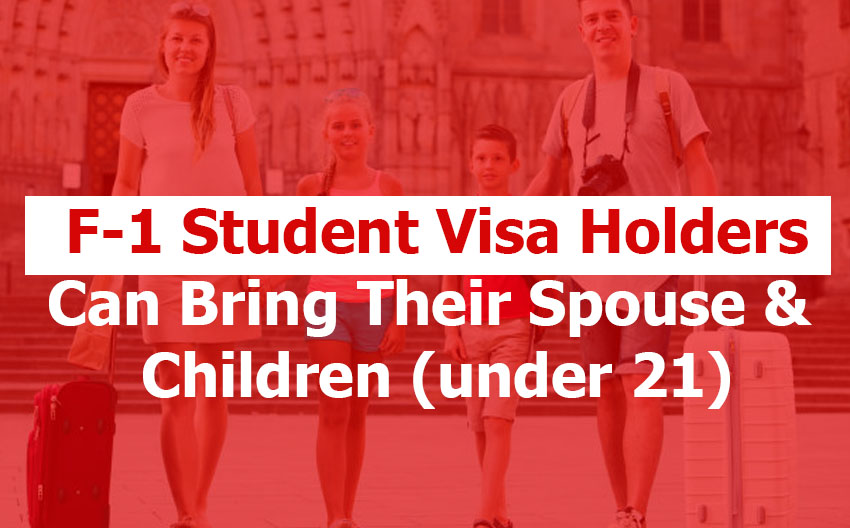
Can F-1 Student Visa Holders Bring Their Spouse and Children? When an international student is accepted into a U.S. academic program on an F-1 visa, a vital concern is often whether they can keep their family together while studying abroad. The short answer is yes—an F-1 visa holder can bring their legal spouse and unmarried children under age 21 to the United States under an F-2 dependent visa, but the rules are detailed, restrictive by design, and essential to understand thoroughly before planning travel or relocation. Broadly, the F-2 dependent classification is available only to a legally married spouse and unmarried minor children under 21 years old, and each dependent must obtain their own Form I-20 issued in their name to apply for an F-2 visa at a U.S. Embassy or Consulate.
The purpose of the F-2 visa is not to grant the same privileges as an F-1 student visa. It exists to keep families together while the principal F-1 student visa holder pursues full-time study, but with defined limitations on work, study, and duration of stay that reflect U.S. immigration policy. Dependents on an F-2 visa must maintain their status as long as the F-1 student does, and any loss of F-1 status automatically ends the F-2 dependent’s status as well.
In this comprehensive guide, we will go deep into eligibility requirements, step-by-step application processes, restrictions on employment and study, financial obligations, timing and entry rules, and strategic planning tips for families. We will also provide comparison tables tailored for featured snippets on key questions such as “work rights for F-2 spouses” and “study rights for F-2 children.” If you want to keep your family together in the U.S., this is the guide that explains both what the law says and what that means in real life.
Eligibility: Who Qualifies for an F-2 Dependent Visa?
One of the most fundamental elements of the F-2 dependent system is precise eligibility. According to the U.S. Department of State and U.S. Citizenship and Immigration Services (USCIS), only the spouse of an F-1 student and unmarried children under 21 years old qualify for F-2 dependent status. No other relatives—parents, siblings, cousins, or extended family—are permitted under the F-2 classification. This means that a dependent’s status is strictly defined by both marital status (for spouses) and age/relationship (for children).
Each F-2 dependent must be issued a separate I-20 Form in their own name. This separate I-20 is not optional: it is an absolute requirement for visa issuance and entry into the U.S. When the dependents apply for the F-2 visa at a U.S. Embassy or Consulate, they must present their own I-20, passport, and supporting documents showing the relationship (marriage certificate for a spouse; birth certificate for a child). Importantly, the dependent I-20s carry their own SEVIS IDs and are governed by the same tracking system as the F-1 visa holder’s I-20.
A key feature of F-2 eligibility is that dependents may enter the United States either at the same time as the primary F-1 student or at a later date, usually within 30 days after the F-1 student is lawfully admitted and enrolled in a full course of study. This flexibility reduces the pressure on families who cannot travel together immediately due to financial, logistical, or scheduling reasons. However, dependents cannot enter before the F-1 student has established status in the U.S. — the visa system explicitly restricts that.
Timing matters: when dependents seek admission to the U.S. under F-2 status, the principal F-1 student must be enrolled in a full course of study or engaged in approved practical training following completion of studies. This requirement is meant to prevent dependents from maintaining status loosely when the F-1 student is not actively in valid status.
Finally, eligibility is contingent on proper relationship documentation and financial backing. U.S. consular officers can request proof of marriage or parentage, and schools often require demonstration of sufficient funds for each dependent on an I-20 request. These financial requirements are part of ensuring that the F-2 visa is financially sustainable for the family without relying on unauthorized work.
Application Process: Step-by-Step for F-2 Visas
Bringing dependents to the U.S. on an F-2 visa is a formal process that involves coordination between your school’s international office, the U.S. Embassy or Consulate, and the SEVIS system. The process typically follows these long, detailed phases:
First, the F-1 visa holder must inform their Designated School Official (DSO) that they intend to bring dependents. The DSO issues a separate Form I-20 for each dependent, reflecting names, birthdates, passport information, and proof of relationship. It’s crucial that these forms are issued before the embassy visa interview — consular officers will not issue an F-2 visa without the dependent’s own I-20.
Second, families must prepare to submit the I-20s along with supporting documentation at the U.S. Embassy or Consulate when they schedule their F-2 visa interviews. Typical documents include valid passports, birth certificates, marriage certificates, evidence of financial support, and proof that the F-1 student is enrolled in a full program of study. Embassies also require visa application forms (DS-160) and might request proof of ties to the home country.
Third, once the visa is granted, dependents may enter the United States anytime during the validity of the F-2 visa, provided the F-1 student is maintaining their status. The I-20 must be signed for travel within six months before entry. Upon arrival, U.S. Customs and Border Protection (CBP) will inspect the dependents at the port of entry and assign an I-94 record for each, reflecting their status and authorized period of stay.
Fourth, dependents do not pay a separate SEVIS fee. While the principal F-1 visa holder pays the SEVIS I-901 fee for their own I-20, dependents on F-2 status are exempt, even though they carry individual I-20s. This exemption is important in financial planning when calculating overall costs to bring dependents.
Lastly, if dependents are already present in the U.S. on a different visa (like B-2 tourist or H-4), they may apply for a change of status to F-2 through USCIS without leaving the country. This requires filing Form I-539 and waiting for approval before the change of status takes effect. It’s a separate pathway but often chosen to avoid international travel during complex situations like pandemics or family commitments.
Employment and Study Rights: Limits and Options for F-2 Dependents
One of the most misunderstood parts of F-2 visa rules is what dependents can and cannot do once they are in the United States. Under U.S. immigration regulations, F-2 dependents are strictly prohibited from employment of any kind, whether paid or unpaid, and this applies both to spouses and children. This rule is rooted in separate treatment of student versus dependent intent — the dependent status is designed to preserve family unity, not to permit labor force participation.
This prohibition includes volunteering or internships that would otherwise be considered work. The structural reason is that the U.S. immigration system ties employment rights to specific visa classifications (like F-1 with on-campus work or OPT/CPT, H-1B for specialty occupations, etc.). F-2 dependents may not obtain a Social Security Number (SSN) because employment is not permitted under their visa.
Study rights are similarly constrained. While F-2 children may attend elementary and secondary school (K-12) full-time, this is an exception reflecting compulsory education norms in the United States. In contrast, F-2 spouses are not permitted to enroll in full-time degree programs. Spouses may engage in part-time study that is “avocational or recreational” — such as hobby classes, arts, language courses, or part-time community classes — but they cannot pursue a degree while maintaining F-2 status.
If an F-2 dependent wishes to pursue full-time academic study or employment, they must first change status to F-1 (or another classification that permits work/study). This requires filing a change of status application with USCIS and waiting for approval before beginning full-time studies or employment. This process may take several months, during which the dependent must remain lawfully in status.
In essence, F-2 status is intentionally limited to family accompaniment, not full academic or economic participation. While these restrictions may seem austere compared with policies in other countries, they are consistent with the way U.S. nonimmigrant categories separate the purpose of each visa.
Financial Proof & Accommodation: What You Must Show
A crucial hurdle in the F-2 process is financial evidence. U.S. immigration regulations expect the F-1 student (or their sponsor) to prove that they can financially support both their own studies and all F-2 dependents without recourse to unauthorized employment. Many schools set specific minimums — for example, requiring additional annual funds per spouse and per child — and these amounts vary by institution and location due to cost of living differences.
Typical documentation includes bank statements, affidavits of support, scholarship or assistantship award letters, and sponsor letters showing that funds exist and are available. Proof of adequate funds is not just for the initial visa interview — it may be reviewed by the DSO when issuing the dependent I-20 and again at the port of entry by CBP officers. Insufficient documentation often leads to visa refusal or delayed processing.
Accommodation evidence may also be requested. While U.S. law does not explicitly require showing housing arrangements, consular officers and DSOs sometimes ask for evidence of sufficient space and living conditions for the family, especially when dependents are young children. This reflects practical considerations around health, welfare, and public support systems.
In many cases, the financial burden of supporting dependents significantly increases overall costs. Families must account for living expenses, health insurance (often mandatory for both F-1 and F-2), schooling costs for children, and travel expenses. When planning, it’s essential to factor these into financial documentation early, as gaps can cause visa delays.
Finally, as with any visa category, financial proof must be genuine and current — stale or unverifiable documents raise red flags at consulates. Conservative preparation and institutional support are vital.
Duration of Stay & Loss of Status: What Happens When Things Change
F-2 dependent status is inextricably linked to the F-1 student’s status. If the principal F-1 visa holder loses legal status — for example, if they withdraw from their program, drop below full-time enrollment without authorized leave, or otherwise violate their conditions — all F-2 dependents immediately lose their dependent status as well. They must either depart the U.S. or apply for a change to another valid status (such as B-2 visitor status).
Dependents may remain in the U.S. for as long as the F-1 student’s status is valid, including authorized periods of Optional Practical Training (OPT). However, once the F-1 student completes their program and enters the 60-day grace period to depart the U.S., the F-2 dependents have the same departure requirement. Staying behind without valid status leads to immigration violations.
Children on F-2 status automatically lose their dependent eligibility when they turn 21, at which point they must either adjust to another visa category (such as F-1 in their own right) or depart the U.S. This age cutoff is strictly enforced and is not waived except under very limited conditions.
Travel outside the U.S. and reentry on an F-2 visa requires valid travel signatures on the I-20s, valid passports, and valid F-2 visas. Dependents should never travel without ensuring that their I-20 travel signature is up to date; failure to have it can lead to denied reentry.
Understanding these timing and status dependencies is essential for long-term planning because family unity in the U.S. is conditional on compliance at every stage.
Comparison Tables (F-2 Visa Application)
F-2 Dependent Work & Study Rights
| Activity | F-2 Spouse | F-2 Child (Under 21) |
|---|---|---|
| Employment | ❌ Not permitted under any circumstances | ❌ Not permitted under any circumstances |
| Full-Time Study | ❌ Not permitted; must change to F-1 | ✔ Permitted at K-12 grade (public/private) |
| Part-Time or Recreational Study | ✔ Permitted (hobby/recreation) | ✔ Permitted (K-12 + recreational) |
| Requirement to Get SSN | ❌ Not eligible | ❌ Not eligible |
F-2 Visa Application Documentation Checklist
| Document | Purpose | Notes |
|---|---|---|
| Separate I-20 for Each Dependent | Visa issuance and SEVIS tracking | Must be issued by DSO before visa appointment |
| Proof of Relationship | Spouse/Child eligibility | Marriage certificate; birth certificates |
| Financial Evidence | Ability to support dependents | Bank statements; sponsor letters |
| Valid Passport | Entry/visa processing | 6+ months validity recommended |
| Visa Application (DS-160) | Consular processing | Completed separately for each dependent |
Common Questions: F-2 Visa Application
Can dependents come after the student has already arrived?
Yes. F-2 dependents may apply for visas later and join the F-1 student at any point during valid status — as long as the F-1 student remains in full compliance with enrollment and SEVIS requirements.
Can a spouse work while the student is on OPT?
No. F-2 status does not change simply because the student is working under OPT. Dependents still cannot work unless they change to an eligible status (like F-1 or a work visa).
Can F-2 children attend school?
Yes, children can attend elementary, middle, and high school full-time. This is one of few educational rights F-2 status explicitly permits.
What happens when a child turns 21?
They lose F-2 status and must change to another valid immigration category (like F-1) or leave the U.S.
Can dependents receive health insurance?
Insurers usually require dependents to be listed on a student’s policy; they should ask the university’s international office for guidance on dependent coverage.
Conclusion: F-2 Dependents Are Permitted—With Trade-Offs
The U.S. F-2 dependent visa system does legally allow spouses and children under 21 to join an F-1 student in the United States, but it is structured with clear limits on work and study rights that reflect U.S. nonimmigrant policy priorities. Keeping your family together while you pursue a degree can be done, but you must plan carefully around documentation, funding, status compliance, and timing.
For many families, the decision to bring dependents hinges not just on the law but on practical factors: finances, educational goals, and long-term plans after graduation. Understanding the restrictions and opportunities of F-2 status equips you to make informed choices and reduces the risk of disruption in the middle of your academic journey.