
Few programs in college football carry a story as distinctive as Brigham Young University football, a team shaped not only by athletic ambition but by institutional identity and cultural continuity. The BYU Cougars football represent Brigham Young University in Provo, Utah, competing at the highest level of the NCAA Football Bowl Subdivision. Official athletic information, schedules, and records are maintained at https://byucougars.com, while national rankings and historical archives can be reviewed at https://www.ncaa.com and Sports Reference (https://www.sports-reference.com/cfb/). From modest regional beginnings to national championship heights and, most recently, entrance into the Big 12 Conference, BYU football has navigated transformation without surrendering its core character.
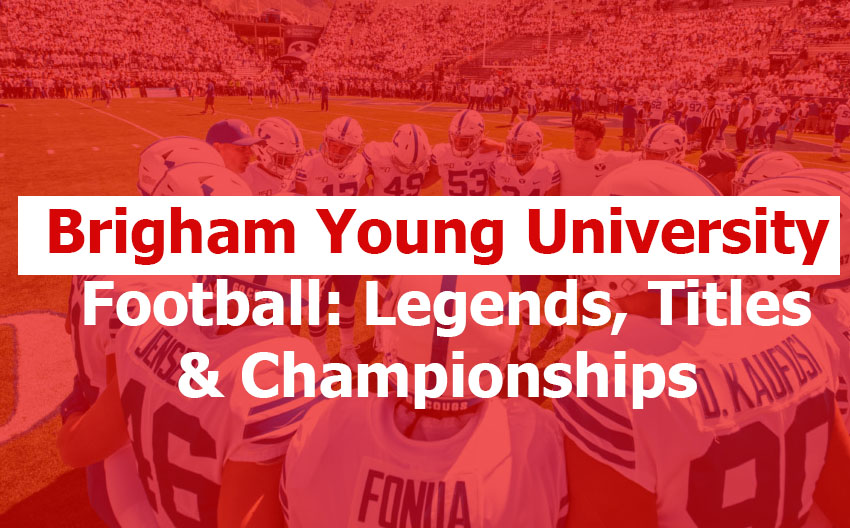
Brigham Young University Football
Set against the Wasatch Mountains, Provo provides a dramatic natural amphitheater for competition. The program’s home, LaVell Edwards Stadium, seats more than 60,000 fans and has witnessed some of the most audacious offensive performances in modern college football history. The stadium is not the largest in the sport, but it possesses a distinct intimacy, where crisp mountain air carries the sound of the Cougar fight song across autumn evenings. Attendance figures consistently demonstrate regional loyalty, while national broadcasts during signature games have amplified BYU’s reach far beyond Utah’s borders.
The identity of BYU football is inseparable from intellectual boldness and strategic innovation. Where other programs leaned into defensive conservatism in the late 20th century, BYU leaned forward—literally—into the passing game. That audacity did not emerge by accident. It was cultivated by leadership that understood how to exploit inefficiencies in the game’s strategic equilibrium. The result was a program that challenged orthodoxy and reshaped offensive philosophy across the sport.
Origins and the LaVell Edwards Revolution
BYU football began in 1922, but its ascent to national prominence arrived under LaVell Edwards, who became head coach in 1972. Edwards possessed a mind that recognized opportunity where others saw risk. At a time when many teams prioritized ground-and-pound offense, Edwards constructed a pass-heavy attack that would later influence the entire sport. His philosophy was simple but radical: throwing the football frequently was not reckless; it was efficient when executed with precision. That intellectual gamble reshaped BYU’s identity and, eventually, college football itself.
The statistical output under Edwards was staggering. Quarterbacks routinely posted numbers that dwarfed national averages. Opponents struggled to adapt defensively to the tempo and vertical aggression. Edwards’ system did not merely win games; it expanded tactical imagination. Analysts and historians often cite BYU’s passing dominance as a precursor to the spread offenses that would later dominate the 21st century. Archival data and season-by-season breakdowns are available through NCAA records and the College Football Data Warehouse.
The crowning achievement of this era came in 1984, when BYU completed a perfect 13–0 season and was crowned national champion by the AP Poll. That championship remains one of the most debated and discussed titles in college football history, largely because BYU was not a member of a traditional power conference at the time. Critics questioned strength of schedule; supporters pointed to undefeated excellence. Regardless of debate, the championship stands in the official record books, a testament to strategic daring and disciplined execution.
Comparison: 1984 National Title Context
| Category | BYU 1984 | Typical Power Program |
|---|---|---|
| Record | 13–0 | 11–1 or 12–1 |
| Offensive Identity | Pass-heavy | Balanced or run-focused |
| Conference Status | WAC | Major power conference |
| Final Ranking | AP #1 | AP #1 |
Quarterback Legacy and NFL Pipeline
If BYU football were a novel, the quarterback position would be its protagonist. From Steve Young to Ty Detmer and Zach Wilson, the program has consistently produced signal-callers capable of translating collegiate success into professional opportunity. Young, who later achieved Hall of Fame status in the NFL, embodied dual-threat intelligence. Detmer captured the Heisman Trophy in 1990, reinforcing BYU’s reputation as a quarterback incubator. Wilson’s meteoric rise to a top NFL Draft selection underscored the program’s continued relevance in modern recruiting cycles.
The throughline among these players is developmental infrastructure. BYU’s offensive system historically demanded pre-snap recognition, timing precision, and deep-field accuracy. These are not merely physical traits but cognitive ones. Professional scouts often note that BYU quarterbacks enter the NFL with advanced understanding of route trees and coverage schemes. Draft statistics and professional performance data can be examined at https://www.pro-football-reference.com.
Beyond quarterbacks, BYU has produced notable defensive standouts and linemen, but the passing game remains its signature export. This specialization does not imply limitation; it reflects mastery. When a program refines a particular competency over decades, it builds institutional memory that compounds. Coaches mentor successors. Film archives inform innovation. Culture reinforces expectation.
Notable BYU Quarterbacks
| Player | College Achievement | NFL Outcome |
|---|---|---|
| Steve Young | Elite passer, national acclaim | Pro Football Hall of Fame |
| Ty Detmer | Heisman Trophy winner | Long NFL career |
| Zach Wilson | Top NFL Draft pick | Franchise quarterback potential |
Conference Realignment and Big 12 Era
For decades, BYU navigated independence, balancing national scheduling ambition with logistical challenges. Independence provided flexibility but required meticulous planning. Without conference affiliation, every season demanded careful orchestration to secure competitive opponents and postseason opportunities. That balancing act shaped BYU’s national brand: willing to travel, willing to compete anywhere, willing to prove itself repeatedly.
In 2023, BYU formally joined the Big 12 Conference, marking a structural shift in its competitive environment. The move aligned BYU with established programs and guaranteed annual high-profile matchups. Conference membership enhances recruiting appeal, revenue stability, and playoff pathways under the expanded College Football Playoff format. Official conference information and standings are available at Big12Sports.com.
Transitioning into the Big 12 introduces new strategic variables. Depth becomes more critical when weekly competition intensifies. Recruiting pipelines must expand geographically. NIL frameworks must compete with peer institutions. Yet history suggests that BYU thrives under structural evolution. The program’s 1984 championship occurred outside traditional power structures; its Big 12 era now places it firmly within them.
Comparison: Independence vs Big 12 Membership
| Factor | Independence Era | Big 12 Era |
|---|---|---|
| Scheduling | Flexible, complex | Structured conference slate |
| Recruiting | National niche appeal | Enhanced Power Five credibility |
| Playoff Access | Limited leverage | Direct pathway via conference title |
Rivalries, Culture, and the Road Ahead
Rivalries remain central to BYU’s emotional architecture. Annual clashes with Utah Utes football ignite statewide intensity. Known as the “Holy War,” this rivalry transcends standings, reflecting geographic proximity and cultural contrast. Games frequently hinge on narrow margins, reinforcing the psychological stakes embedded in tradition.
BYU’s cultural identity distinguishes it nationally. The university’s honor code shapes roster composition and public perception. Critics sometimes frame this as limitation; supporters describe it as cohesion. What remains indisputable is that culture influences performance. Programs with shared identity often exhibit resilience under pressure. That resilience has surfaced repeatedly in BYU’s history.
Looking forward, the expanded College Football Playoff and evolving NIL landscape introduce fresh opportunity and uncertainty. Recruiting strategy must balance tradition with modern marketing dynamics. Player development must adapt to faster offensive tempos across the sport. Yet the deeper foundation—discipline, preparation, institutional alignment—remains intact.
Comparison: Program Strength Indicators
| Metric | BYU | Big 12 Average |
|---|---|---|
| National Titles | 1 (1984) | 0–1 typical |
| Stadium Capacity | 60,000+ | 55,000–65,000 |
| Heisman Winners | 1 | 1–2 historic |
-
“Brigham Young University football team at LaVell Edwards Stadium”
-
“BYU Cougars quarterback throwing during Big 12 conference game”
Brigham Young University football stands as proof that innovation can arise from unexpected places and that tradition need not resist evolution. From the bold passing revolution under LaVell Edwards to the structural shift into the Big 12, BYU has navigated change with conviction. The mountains surrounding Provo are ancient, carved by time and pressure. The program beneath them reflects a similar endurance—rooted, adaptive, and unafraid to throw deep when the moment demands courage.