
Oklahoma University football is not merely a sports program; it is an inheritance passed down through generations of crimson-clad believers who measure autumn by kickoff times and judge eras by championship banners. The story begins at the University of Oklahoma, where the Sooners have built one of the most formidable and statistically accomplished traditions in college football history. Official program records and updates can be found through the athletics department at https://soonersports.com, while national championship documentation and historical statistics are archived by the NCAA at https://www.ncaa.com. From its earliest days on dusty Oklahoma fields to its transition into modern super-conference competition, Oklahoma football has consistently embodied a ruthless competitive standard that refuses to soften with time.
Oklahoma University Football: Tradition, Titles, and the Relentless Standard
The team known formally as Oklahoma Sooners football has captured multiple national championships, produced Heisman Trophy winners, and sustained relevance across wildly different eras of the sport. That kind of durability does not happen by accident. College football changes constantly—rules evolve, offensive systems mutate, recruiting geographies expand, and financial stakes rise into the stratosphere—yet Oklahoma remains stitched into the national conversation year after year. There is an institutional confidence in Norman that borders on inevitability, a belief not rooted in arrogance but in accumulated proof.
To understand Oklahoma University football is to understand that excellence has been normalized. Seasons that would define other programs are considered stepping stones in Norman. Ten wins are not a fairy tale; they are a baseline expectation. Conference titles are not rare jewels; they are milestones on a larger journey toward national supremacy. This relentless calibration of ambition shapes recruiting, coaching hires, fan culture, and player development alike.
At its core, Oklahoma football reflects the character of the state itself: resilient, direct, fiercely proud, and unwilling to yield quietly. The Sooners play in a region where football is not an accessory but a cultural backbone. Friday nights belong to high schools, Saturdays to the Sooners, and Sundays are reserved for analysis and argument. The program’s legacy is inseparable from this rhythm of life.
As we move through the layers of history, dominance, rivalry, infrastructure, and future trajectory, one theme persists: Oklahoma football does not drift. It recalibrates. It reloads. It rebuilds when necessary. And then it charges forward again.
Origins and Early Foundations of Oklahoma Football
Oklahoma football’s origins trace back to 1895, when the fledgling university fielded its first team in a sport still defining itself. Early contests were chaotic by modern standards—minimal protective gear, fluid rule interpretations, and a rawness that mirrored the frontier spirit of the territory itself. Yet even in those formative years, the Sooners displayed a competitive instinct that would later become institutional doctrine. The team was not yet a national power, but the seeds of ambition were unmistakable.
By the early 20th century, Oklahoma began carving out regional respect. Conference affiliations shifted as the college football landscape reorganized, but the program steadily accumulated victories and sharpened its identity. The Sooners embraced disciplined preparation and physical dominance, hallmarks that would echo through subsequent decades. The early coaching hires reflected a recognition that stability breeds growth. Oklahoma invested in continuity long before it became fashionable.
The 1940s and 1950s would alter the trajectory of the program permanently. Under the leadership of Bud Wilkinson, Oklahoma ascended into national supremacy. Wilkinson engineered one of the most astonishing achievements in sports history: a 47-game winning streak from 1953 to 1957, a record that still stands at the highest level of major college football. That streak was not fueled by luck; it was built on tactical clarity, physical conditioning, and psychological dominance.
Wilkinson’s teams were structured machines. They executed with precision and punished mistakes ruthlessly. Opponents entered games knowing they faced not just talent but cohesion. The Sooners’ rise during this period cemented Oklahoma’s place in the national imagination. Championships in 1950, 1955, and 1956 announced that Norman was not a temporary hotspot but a permanent power center.
The foundation laid during these decades established a template: recruit nationally, develop relentlessly, innovate strategically, and never lower expectations. That template would prove adaptable enough to survive every transformation college football would later undergo.
Championship Pedigree and Sustained Dominance
Oklahoma’s national championships span multiple eras, each shaped by distinct offensive philosophies and coaching personalities. Beyond the Wilkinson years, the program surged again under Barry Switzer, who led the Sooners to national titles in 1974, 1975, and 1985. Switzer embraced a wishbone offense that overwhelmed defenses with option-based precision and raw athleticism. His teams combined swagger with substance, dominating physically while projecting an unmistakable confidence.
The 1985 national championship squad exemplified Oklahoma’s adaptability. While many programs flirted with passing-heavy approaches, the Sooners leaned into their strengths: power running, suffocating defense, and relentless tempo. Championships were not aesthetic experiments; they were demonstrations of efficiency. Oklahoma’s identity was not about flash but about execution.
The modern era introduced new dimensions. Under Bob Stoops, Oklahoma reclaimed national prominence with a 2000 national championship that reestablished the program’s dominance in the BCS era. Stoops’ teams balanced explosive offense with opportunistic defense, marking a philosophical evolution from pure option football to a more diversified attack.
The offensive revolution accelerated under Lincoln Riley, whose quarterback development pipeline became legendary. Heisman Trophy winners and finalists flourished in Norman, turning Oklahoma into a quarterback factory. The Sooners consistently ranked among the nation’s top offenses, redefining their identity once again without abandoning their competitive backbone.
This sustained dominance across radically different eras underscores a central truth: Oklahoma football is not bound to one system. It is bound to a standard. The ability to reinvent while preserving excellence separates dynasties from fleeting contenders.
Comparison: Oklahoma National Championships
| Era | Head Coach | National Titles | Signature Identity |
|---|---|---|---|
| 1950s | Bud Wilkinson | 3 | Defensive precision & winning streak |
| 1970s–80s | Barry Switzer | 3 | Wishbone power dominance |
| 2000 | Bob Stoops | 1 | Balanced modern resurgence |
Sources: NCAA Records (https://www.ncaa.com) and official athletics archives (https://soonersports.com)
Rivalries That Define the Program
No discussion of Oklahoma University football is complete without examining the Red River rivalry against the Texas Longhorns football. Played annually at the Cotton Bowl in Dallas during the State Fair of Texas, this matchup splits the stadium evenly between crimson and burnt orange, creating one of the most visually and emotionally charged atmospheres in sports. The rivalry is documented historically through both universities and the NCAA archives.
The Red River showdown is not simply a game; it is a referendum on pride. Records reset emotionally when Oklahoma and Texas meet. National rankings often dissolve into irrelevance. The rivalry’s longevity amplifies every triumph and magnifies every defeat. Generations define themselves by singular plays in this contest.
Beyond Texas, Oklahoma’s historical battles with Nebraska Cornhuskers football during the Big Eight era forged another iconic rivalry. Those matchups frequently carried national championship implications and represented philosophical clashes between power football juggernauts. Though conference realignment has reduced the frequency of these meetings, the memory lingers in highlight reels and championship retrospectives.
Rivalries shape identity because they provide narrative tension. For Oklahoma, these matchups sharpen competitive focus and reinforce tradition. They are emotional accelerants in a program already fueled by expectation.
In a sport increasingly reshaped by conference expansion, Oklahoma’s rivalries remain anchors to history. They remind players and fans alike that football is not only about standings but about stories passed down through decades.
H2: Stadium, Fan Culture, and Institutional Infrastructure
Gaylord Family Oklahoma Memorial Stadium stands as a monument to the program’s scale and ambition. With a capacity exceeding 80,000, it transforms on game days into a sea of crimson noise that can rattle even the most composed visiting teams. The stadium has undergone significant renovations to ensure competitive parity in facilities and fan experience, reflecting the financial realities of modern college athletics.
Sellout crowds and national broadcasts reinforce Oklahoma’s brand visibility. Game day in Norman is choreographed tradition: tailgates stretching across campus lawns, the Pride of Oklahoma marching band echoing through corridors, and a fan base that expects not merely participation but victory. The psychological effect of such unified expectation can be both motivating and unforgiving.
Infrastructure extends beyond the stadium. Investment in training facilities, nutrition programs, sports science, and academic support systems reflects a holistic understanding of athlete development. Competing at the highest level requires more than playbooks; it demands institutional coordination.
The university’s academic reputation also intertwines with athletics. As part of a major research institution, Oklahoma balances athletic ambition with scholarly credibility, reinforcing its standing nationally. Official academic information can be found at https://www.ou.edu.
Ultimately, infrastructure is the skeleton beneath performance. Oklahoma’s sustained competitiveness reflects a willingness to modernize facilities without compromising tradition.
Transition to the SEC and the Future of Oklahoma Football
Oklahoma’s move into the Southeastern Conference represents a seismic shift in competitive landscape. The SEC is widely regarded as the most physically demanding conference in college football, boasting perennial national contenders and elite recruiting territories. Transitioning into this arena signals Oklahoma’s confidence in its brand strength and competitive resilience.
The move introduces new rivalries and amplifies national exposure. Weekly competition against SEC programs will test depth, defensive fortitude, and recruiting adaptability. Success in this environment demands both cultural continuity and schematic flexibility.
Recruiting dynamics will inevitably evolve. Proximity to Texas recruiting pipelines remains advantageous, but expanded SEC visibility enhances national appeal. NIL opportunities and conference revenue distributions further shape competitive balance.
The path forward is neither guaranteed nor predetermined. It is a working theory in motion—one shaped by coaching decisions, player development, and strategic patience. Programs entering new conferences often face adjustment periods, but Oklahoma’s history suggests resilience under pressure.
In the grand sweep of college football history, Oklahoma University football has thrived through transformation. The Sooners have weathered rule changes, conference realignments, coaching transitions, and cultural shifts. What remains constant is expectation. Not hope. Not nostalgia. Expectation.
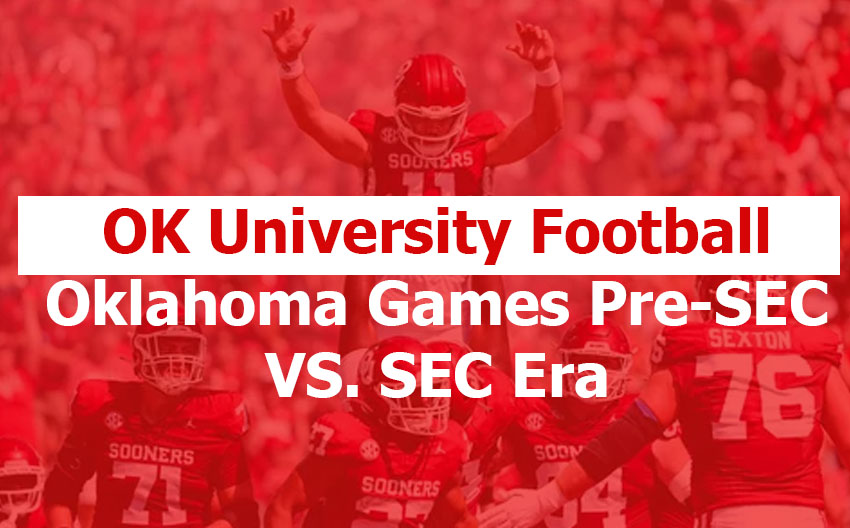
Comparison: Oklahoma Pre-SEC vs. SEC Era
| Era | Conference | Competitive Landscape | National Impact |
|---|---|---|---|
| Big 12 Era | Big 12 Conference | High-scoring offenses | Frequent CFP contention |
| SEC Era | SEC | Defensive powerhouses | Elevated national scrutiny |
Sources: SEC Official Site (https://www.secsports.com) and NCAA archives (https://www.ncaa.com)
Red River Rivalry Oklahoma vs Texas at Cotton Bowl
Final Wrap
Oklahoma University football stands not as a relic of past glory but as an evolving institution built on championship architecture. Its history is layered with dominance, rivalry, reinvention, and ambition. In a sport defined by volatility, Oklahoma’s consistency is its defining trait. The Sooners do not simply participate in college football history; they author it, season after season, recalibrating their standard and marching forward under the unblinking expectation of greatness.