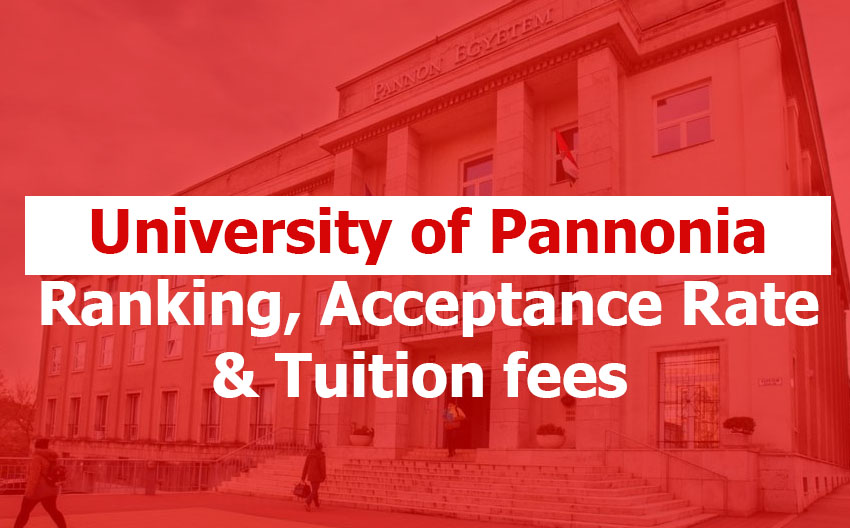
The University of Pannonia (Pannon Egyetem) in Veszprém, Hungary is a public university founded in 1949 with a wide portfolio of Bachelor’s, Master’s, and PhD programmes spanning engineering, economics, humanities, informatics, and interdisciplinary applied sciences. It is ranked in the QS World University Rankings #1201–1400 (2026) and holds respectable regional positions in European and Emerging Europe & Central Asia university tables, with disciplinary strengths in engineering and business.
Pannonia offers accessible admissions with clear documentation requirements and English proficiency thresholds, structured tuition ranging from about €1,500 to €2,000 per semester, and relatively affordable living costs around 60,000–80,000 HUF/month (excluding accommodation).
Admission includes academic transcripts, language qualification at B2 CEFR level, registration fees, and sometimes tests or interviews, with scholarships available, including Stipendium Hungaricum.
Rankings and Academic Reputation: Where the University of Pannonia Stands
The University of Pannonia’s academic footprint is best understood through a layered view of multiple global and regional ranking systems that reflect institutional scope, research activity, and student outcomes.
According to the QS World University Rankings 2026, Pannonia is positioned within the #1201‑1400 band globally, a placement that situates it among a broad set of established research universities around the world rather than within elite top‑tier categories, an important indicator for prospective students evaluating global visibility and competitive recognition. This placement in the QS tables reflects both ongoing development in research intensity and a steadily expanding international presence, consistent with the university’s evolution since its establishment in 1949 and rebranding to University of Pannonia in 2006.
In addition to global rank, Pannonia’s performance in more regionally focused tables highlights its resonance in Europe and Emerging Europe & Central Asia (EECA) contexts. QS data show positions such as #=476 in the Europe University Rankings and around #59 in the Eastern Europe University Rankings, indicators that the institution holds a respectable footing relative to peers across an academically dynamic region.
Students often find that these regional placements correlate more closely with graduate opportunities and employer perceptions than broad global bands, especially for programmes tied to local industry and economic sectors in engineering and business, making them a useful measure of practical academic weight.
The university’s subject‑level presence also carries meaning: engineering streams show competitive placements in subject ranking analyses, and Pannonia’s research output, particularly in areas like chemical engineering and environmental science, contributes to its scholarly profile.
Such a disciplinary focus reflects a strategic alignment with regional economic needs and global sustainability trends, drawing students interested in applied research and vocationally oriented programmes. Furthermore, some internal Hungarian national publishers and historical rankings have placed Pannonia among the top institutions for lecturer excellence and research, underscoring strengths that may not be immediately visible in broad global tables but which resonate within national academic ecosystems.
The university has also garnered specific accreditation and reputation signals that hint at quality, such as AACSB accreditation for its Faculty of Business and Economics, a hallmark recognised globally for rigorous business education standards. Such professional accreditations often carry more direct meaning for student outcomes and employer recognition than general ranking numerical positions, especially in fields where industry standards and graduate employability are paramount.
Overall, the University of Pannonia’s ranking profile is one of a solid mid‑range global institution with regional strengths, notable disciplinary achievements, and an evolving international reputation. While not positioned among the very highest global ranks, it offers credible academic standing and growing international integration, an important context for understanding the value of its degrees in a European and global labour market.
Acceptance Rate and Competitiveness: How Selective Is Admissions at Pannonia
Determining the specific acceptance rate at the University of Pannonia requires synthesising available admissions data and contextual cues from Hungarian higher education norms. Unlike many U.S. or UK universities that publish explicit acceptance percentages, Hungarian institutions often use qualitative threshold‑based admissions, where meeting academic and documentation requirements plays a larger role than beating out a statistical pool of applicants. Nonetheless, some external sources estimate that Pannonia’s acceptance rate can fall in the broad range of 30–40%, indicating a competitive environment where applicants should meet clearly articulated academic criteria to ensure favourable outcomes.
The admissions process at Pannonia emphasises meeting eligibility thresholds — such as academic performance, language proficiency, and completeness of documentation — rather than competing for scarce seats against hundreds of other applicants as in more highly selective global universities. This structure tends to facilitate successful admission for students who satisfy all prerequisites, particularly in programmes with clear capacity and enrolment limits. At the same time, certain high‑demand or specialised tracks, such as engineering or advanced management programmes, may effectively have tighter competition due to limited capacity and higher preparatory expectations.
International applicants encounter additional layers of competitiveness, particularly where English language proficiency is a baseline requirement. Most English‑taught programmes require evidence of proficiency at the B2 level (IELTS 5.0–6.0 or equivalent), and applicants who fail to demonstrate this early often face either conditional offers or outright refusal until they secure documentation. This emphasises that while the overall acceptance rate might approximate the mid‑30% range, individual chances hinge strongly on how well prepared an applicant is in terms of language and academic record.
Admissions for scholarship pathways such as Stipendium Hungaricum are even more competitive than standard self‑funded acceptance, as these programmes typically involve national and institutional review, quotas, and additional eligibility requirements that effectively raise the bar for admission. Competitive scholarship applicants must demonstrate academic merit, motivation, and often extracurricular or research potential to be nominated and subsequently admitted under the scheme.
Overall, the University of Pannonia’s admissions landscape balances accessibility with academic readiness: meeting the documented requirements and submission deadlines plays a key role in acceptance, but applicants should prepare thoroughly especially around language proficiency and academic record quality to maximise their competitiveness in the process.
Minimum GPA and Admission Requirements: What You Need to Get In
Admission to the University of Pannonia is structured around clear academic and documentation thresholds that differ by level of study (Bachelor’s, Master’s, Doctoral), with specific emphasis on academic achievement and language competence. While Hungary’s university systems traditionally do not publish a single uniform minimum GPA requirement, international admissions guidance suggests an approximate minimum GPA equivalent of ~3.0 on a 4.0 scale for scholarship eligibility and competitive performance in degree tracks, with competitive applicants often above that threshold.
This not only aligns with scholarship eligibility (e.g., University‑based GPAs of 3.0 or higher for institutional scholarships) but also corresponds to general expectations from international student populations in European institutions.
For undergraduate (Bachelor’s) admission, applicants must provide secondary school completion certificates and transcripts, demonstrating a scholastic foundation necessary for academic success. These transcripts should include detailed course results and corresponding grades, and for international applicants, the documentation must be accompanied by certified translations in English or Hungarian if the originals are in a different language. This requirement ensures that admissions committees can accurately assess academic readiness against Hungarian and broader European equivalence standards.
Language proficiency is a core component of admission readiness at Pannonia for programmes taught in English. Applicants are typically required to demonstrate English language ability at the B2 CEFR level, which is frequently evidenced through exams such as IELTS (Band 5 or above) or TOEFL (≥63). Notably, if a candidate has completed previous education fully in English, they may sometimes submit their original certificate in place of a formal test result, providing flexibility while maintaining academic language assurance.
At the Master’s level, beyond presenting a Bachelor’s degree from an accredited institution, applicants often need to supply detailed transcripts, CVs, letters of motivation, and occasionally recommendation letters, especially for programmes where professional experience or research orientation is valued. Programmes with practicum or research components may further require portfolios or documented work experience. This multifaceted approach ensures admissions committees evaluate not just raw numerical indicators but also evidence of intellectual engagement and preparedness for advanced study.
Doctoral (PhD) applicant requirements at Pannonia include proof of a completed Master’s degree with competitive performance, evidence of scholarly or professional work, and language proficiency documentation. Some doctoral schools also assess candidates based on familiarity with research methods and a concise research concept or proposal, integrating qualitative assessment into admissions considerations. Collectively, the admission requirements at the University of Pannonia balance quantitative thresholds like minimum academic performance with qualitative indicators such as motivation and research readiness, providing a comprehensive framework for evaluating student eligibility.
Tuition Fees: What International Students Pay at Pannonia
Tuition at the University of Pannonia varies across programmes and student categories (EU vs non‑EU), but there are transparent mechanisms and published fee structures that help students plan finances. For many Bachelor’s programmes taught in English, the average tuition is around €1,500 per semester, which translates to about €3,000 per academic year a relatively competitive structure in the European context. Master’s programmes tend to command higher fees, often around €2,000 per semester (€4,000 per year), reflecting the deeper academic engagement and additional resource needs associated with graduate education.
Some specialised or interdisciplinary programmes such as certain postgraduate diplomas or engineering tracks offered through specific university centres may have distinct fee bands. For example, a postgraduate diploma in Water System Design or IT specialist training can cost around €1,700 per semester, underscoring that programme type and content intensity shape tuition. These varying bands mirror labour market demands and resource implications of different academic tracks, a common feature of European higher education systems.
An important financial component is the applicant and registration fees: international applicants commonly pay an upfront registration or processing fee (often around €100–€150) at the onset of the admissions process, which is usually non‑refundable and secures administrative processing of the application. For those seeking dormitory placement, an advance accommodation deposit may be requested. For example, around €300 for two months, refundable under specified conditions.
Apart from base tuition and fees, many students offset costs through scholarship opportunities. The popular Stipendium Hungaricum scholarship offers full tuition coverage, a monthly stipend, and accommodation support for eligible international students, dramatically reducing direct education costs and enabling mobility from diverse countries. University‑specific scholarships are also available to self‑funded students, with eligibility often tied to minimum GPA and completion percentage benchmarks (e.g., a GPA ≥ 3.00), providing semester‑based financial support.
When compared with Western European tuition, Pannonia’s fees are generally more affordable, particularly for international students from outside the EU and, when coupled with scholarship programmes, can represent strong value for money given the degree’s market relevance and accreditation. Effective financial planning should account not just for tuition but also for registration fees, accommodation deposits, and eligibility for available funding.
Living Costs: What It’s Really Like to Live in Veszprém
Living in Veszprém, Hungary, where the University of Pannonia is primarily based, combines the charm of a historic Central European town with a notably modest cost of living compared with capital cities. According to official guidance from the university and student cost estimates, typical day‑to‑day expenses excluding accommodation generally range around 60,000 to 80,000 HUF per month (roughly €150‑€200) depending on lifestyle and personal comfort levels. This band covers food, transport, basic utilities, and incidental needs, illustrating that students can plan for a modest monthly outlay while maintaining a reasonable quality of life.
Accommodation is usually the biggest recurring expense. University halls of residence offer comparatively affordable monthly rent, and many students prefer them for convenience and cost savings, though private apartments typically cost more depending on size, location, and whether utilities are included. Pre‑booking and advance deposits are often part of the accommodation process, particularly for international students securing visas, so budgeting for these initial payments alongside monthly rent is essential.
Food and groceries in Veszprém are generally priced lower than in larger European capitals: cooking at home and shopping at discount retailers such as Lidl or Aldi can significantly reduce monthly spending. Transportation costs are similarly modest, with local transit passes or student discounts reducing outlay for buses or other public systems. Personal expenses like mobile phone plans, leisure activities, and occasional dining out add variability but remain within accessible ranges relative to Western European cities.
The University of Pannonia’s environment, near natural attractions like Lake Balaton and surrounded by cultural heritage sites, provides affordable social and recreational opportunities that do not strain budgets, fostering a balanced student life without escalating living costs. Comparatively, total living expenses (including accommodation) often fall comfortably within €4,000–€8,000 per academic year, excluding tuition, reinforcing the appeal of Veszprém as a student‑friendly location.
For international students coming with scholarship support such as Stipendium Hungaricum, the monthly stipend and accommodation allowances play a meaningful role in covering these living costs, enhancing financial sustainability while studying abroad. Planning ahead for seasonal variations in utilities and lifestyle spending helps ensure that budgets align with expected costs throughout the academic cycle.
University of Pannonia Rankings Snapshot
| Ranking System | Position |
|---|---|
| QS World University Rankings 2026 | #1201–1400 globally |
| QS Europe University Rankings | ~#476 |
| QS Eastern Europe Rankings | ~#59 |
| THE World University Rankings | 1501+ |
| QS Sustainability Ranking | =#918 |
Admissions & Academic Requirements
| Requirement | Detail |
|---|---|
| Estimated Acceptance Rate | ~30–40% (varies by programme) |
| Minimum GPA | ~3.0 (indicative for scholarships & competitiveness) |
| English Proficiency | B2 level (IELTS ~5.0–6.0 / TOEFL ~63) |
| Required Documents | Transcripts, certificates, motivation letter, registration fee |
| Interview / Additional Evaluation | May occur for some programmes |
Tuition Fees (per semester)
| Programme Type | Estimated Fee |
|---|---|
| BA (undergraduate) | ~€1,500 / semester |
| MA (graduate) | ~€2,000 / semester |
| Postgraduate Diploma | ~€1,700 / semester |
| Application Fee | ~€100–€150 |
| Dormitory Advance Deposit | ~€300 |
Estimated Living Costs (Veszprém)
| Expense | Monthly Estimate |
|---|---|
| Living Costs (excl. accommodation) | 60,000–80,000 HUF (~€150–€200) |
| Accommodation (varies) | Depends on type (dorm vs private) |
| Total Estimated (year) | ~€4,000–€8,000 (excluding tuition) |
Final Wrap
The University of Pannonia (Pannon Egyetem) stands as a credible and internationally engaged public university in Hungary, offering multidisciplinary academic programmes and steady global and regional rankings. Its QS World University Rankings placement in the #1201–1400 bracket and respected subject rankings combine to position it as a solid choice for students seeking practical, internationally‑relevant degrees.
Admissions balance accessibility with clear academic and language requirements, and while acceptance varies by programme, preparation and documentation quality remain central to success.
Tuition in Hungary, especially for English‑taught programmes, is competitive with much of Europe, and scholarship pathways like Stipendium Hungaricum further reduce financial barriers. Living costs in Veszprém are generally affordable compared with larger cities, adding to the overall value proposition for international education.
Whether you are exploring undergraduate or postgraduate pathways, Pannonia’s offerings blend academic tradition, practical focus, and accessible student life in a scenic Central European setting.
Also Check:
Hungary vs Other European Tuition Comparison: Is Studying in Hungary Expensive?
Which Hungarian University Is Best for My Field? Ranking the Best Programs By University in Hungary