The Institute for AI Policy and Strategy (IAPS) AI Policy Fellowship 2026 stands out as a highly competitive and forward-looking professional development program designed for individuals who wish to shape the future governance of artificial intelligence.
As AI systems become increasingly powerful and influential across economies, governments, and societies, the demand for well-trained policy professionals capable of navigating this complex landscape has grown significantly.
Institute for AI Policy and Strategy (IAPS) AI Policy Fellowship 2026
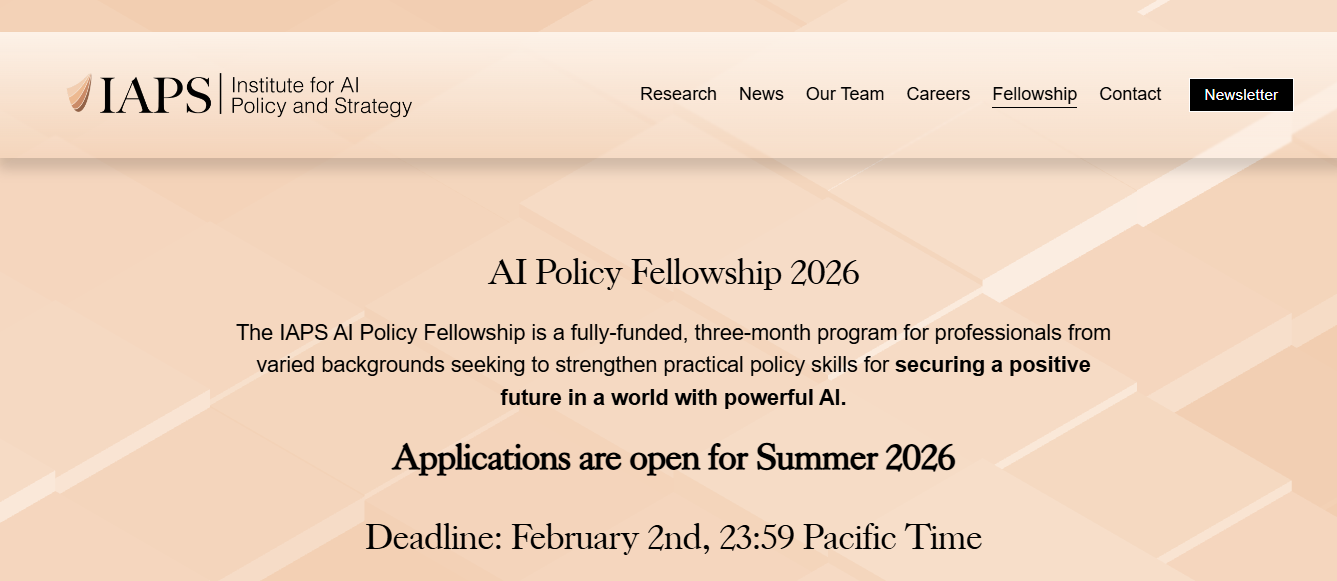
This fully funded fellowship runs for three months and is targeted at young professionals and early- to mid-career individuals from diverse academic and professional backgrounds. Rather than focusing solely on theory, the program emphasizes applied policy work that directly informs national and international decision-making processes.
In response to this global need, the IAPS AI Policy Fellowship has been structured to equip participants with practical policy skills, deep subject-matter exposure, and direct engagement with leading experts working at the forefront of AI governance.
Fellowship Summary Table
| Category | Details |
| Fellowship Name | IAPS AI Policy Fellowship 2026 |
| Host Organization | Institute for AI Policy and Strategy (IAPS) |
| Location | Washington, D.C., or Remote |
| Programme Type | Professional Policy Fellowship |
| Duration | 3 months |
| Programme Dates | June 1–August 21, 2026 |
| Study Level | Undergraduate to Senior Professionals |
| Eligible Applicants | Policy and technical professionals from varied backgrounds |
| Residency Requirement | Mandatory in-person residency in D.C. (June 1–12) |
| Stipend (Fellows) | $15,000 |
| Stipend (Senior Fellows) | $22,000 |
| Funding Type | Fully Funded |
| Application Deadline | February 2, 2026 |
About the IAPS AI Policy Fellowship
The IAPS AI Policy Fellowship was created to address one of the most pressing challenges of the modern era: ensuring that the development and deployment of advanced artificial intelligence systems lead to broadly beneficial outcomes.
As AI capabilities continue to accelerate, policy gaps have become increasingly apparent across areas such as national security, economic competitiveness, public safety, and international stability. Consequently, IAPS has positioned this fellowship as an intensive, hands-on program where emerging policy leaders can gain the skills and experience needed to respond effectively.
Unlike traditional academic fellowships, the IAPS AI Policy Fellowship is practice-oriented. Fellows are immersed in real policy work, guided by mentors involved in AI governance. Participants gain insights into strategic discussions and operational policy aspects.
The program is inclusive, with fellows from undergrads to experienced professionals in government, industry, and think tanks. All share a solid understanding of AI issues, policy priorities, or technical foundations related to the fellowship’s focus.
Programme Structure and Timeline
The IAPS AI Policy Fellowship runs from June 1 to August 21, 2026, spanning a total of twelve weeks. While the program may be completed either fully in person in Washington, D.C., or remotely, all fellows are required to attend a two-week in-person residency at the start of the fellowship.
In-Person Kickoff Residency (June 1–12)
The fellowship begins with an intensive, mandatory residency in Washington, D.C. During this period, fellows are introduced to the AI policy ecosystem through structured sessions, expert briefings, and collaborative discussions. The broader AI policy landscape is explored in depth, allowing participants to understand how different institutions, governments, and stakeholders interact in shaping AI governance.
In addition, fellows are allowed to build strong professional relationships. Through direct interaction with fellow participants, IAPS researchers, and leading AI policy experts, a foundation for long-term collaboration is established. As a result, the kickoff residency is often regarded as one of the most valuable components of the program.
Project Phase and Mentored Work (Remaining 10 Weeks)
Following the residency, fellows spend the remaining ten weeks working closely with an assigned AI policy expert. During this phase, fellows engage in substantive projects that are designed to influence real policy debates at national and global levels. Regular mentorship meetings are held, and progress is continuously reviewed to ensure high-quality outputs.
Depending on individual circumstances, this phase may be completed either remotely or in Washington, D.C. Regardless of location, full-time engagement is expected throughout the fellowship period.
Key AI Policy Focus Areas
The policy domains covered by the IAPS AI Policy Fellowship are deliberately broad yet strategically selected. Fellows may work on topics that include, but are not limited to:
- National security implications of advanced AI systems
- Government acquisition and procurement of AI technologies
- Chemical, biological, radiological, and nuclear (CBRN) risks enabled by AI models
- Export controls and international trade considerations related to AI
- Evaluation and benchmarking of AI systems
- Geopolitics and global competition surrounding AI development
- Hardware-enabled governance mechanisms
- Jurisdiction-specific policy challenges in regions such as the United States, the United Kingdom, and the European Union
Through engagement with these areas, fellows develop a nuanced understanding of how AI policy intersects with broader political, economic, and security concerns.
Nature of Fellowship Projects and Outputs
One of the defining strengths of the IAPS AI Policy Fellowship lies in the tangible outputs produced by participants. Projects are not theoretical exercises; instead, they are designed to generate concrete deliverables that contribute directly to policy conversations.
Depending on the fellow’s background, mentor expertise, and program coordination, projects may take several forms. These have included the drafting of policy briefs and internal memos, delivery of briefings to government officials, and contributions to major research reports. In some cases, fellows have organized large-scale international conferences or published opinion pieces addressing underexplored AI policy issues.
Other fellows have provided strategic advice to think tanks expanding into new jurisdictions, supported the operational development of newly established AI policy organizations, or helped design and run Track II diplomatic engagements. Collectively, these outputs strengthen fellows’ professional track records while producing meaningful policy impact.
Mentorship, Coaching, and Professional Support
In addition to project-based mentorship, fellows receive structured professional development support throughout the program. Weekly one-on-one coaching sessions are held with an IAPS Fellowship Coordinator, during which career planning, productivity, and project management are addressed. This individualized guidance ensures that fellows are supported not only in their immediate work but also in their longer-term career trajectories.
Furthermore, ongoing feedback is provided by IAPS researchers and policy staff. Regular work-in-progress sessions are organized, allowing fellows to present drafts, receive critique, and refine their outputs. Access to IAPS’s extensive professional network is also granted, particularly during the in-person residency in Washington, D.C., where numerous networking opportunities are facilitated.
In select cases, additional financial assistance may be provided to support fellows who are transitioning into new AI policy roles after completing the program.
Financial Support and Stipend
The IAPS AI Policy Fellowship is fully funded, enabling participants to dedicate themselves full-time to the program. Fellows receive a stipend of $15,000 for the three months, while Senior Fellows receive $22,000. This financial support is intended to cover living expenses and to reduce barriers to participation for individuals from diverse socioeconomic backgrounds.
By providing a competitive stipend, the fellowship ensures that participants can focus on producing high-quality policy work without undue financial pressure.
Eligibility and Applicant Profile
The program welcomes applicants from both policy and technical backgrounds, including those with experience in industry, government agencies, academic institutions, and think tanks. There is no strict requirement regarding career stage, as fellows may range from undergraduate students to seasoned professionals.
However, applicants are expected to demonstrate a solid understanding of their chosen subject matter, familiarity with AI policy priorities, or relevant technical expertise. Selection is based on alignment with the fellowship’s mission, demonstrated capacity for impactful work, and potential to contribute meaningfully to AI governance.
Application Deadline and Selection Timeline
Applications for the IAPS AI Policy Fellowship 2026 must be submitted by February 2, 2026. Following a competitive review process, selected candidates will be notified ahead of the program start date. Due to the limited number of fellowship slots and the program’s high standards, early and well-prepared applications are strongly encouraged.
Application link: https://www.iaps.ai/fellowship
MORE RELATED CONTENT:
KAS Scholarship 2026 in Germany (Fully Funded)
University of Oulu Scholarship in Finland 2026
Hungarian Government Bilateral State Scholarships 2026 (Fully Funded)
Turkish Government Scholarships 2026 (Fully Funded)