
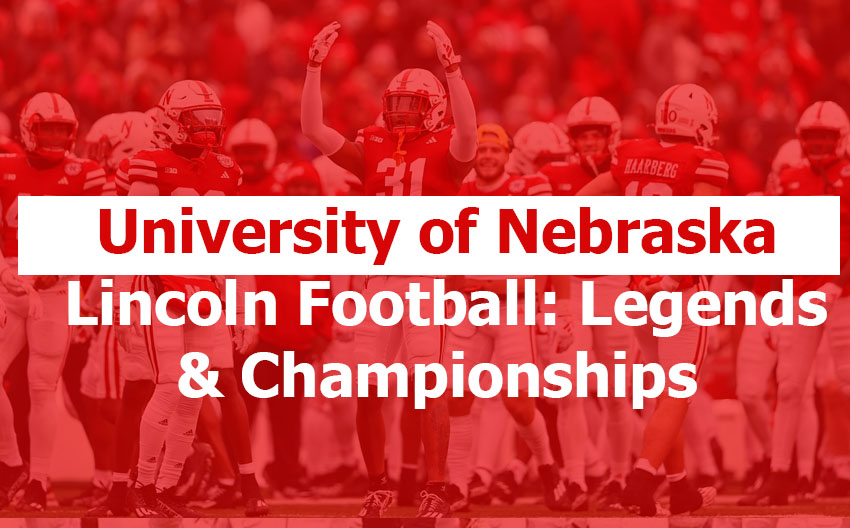
In the vast plains of the American Midwest, where wind bends tall grass and autumn skies stretch wide and unbroken, the story of University of Nebraska–Lincoln football rises like a cathedral built of grit, discipline, and stubborn belief. The Nebraska Cornhuskers are not merely a team; they are a cultural institution, a weekly gathering of red-clad faith in motion. For more than a century, Nebraska Cornhuskers football has shaped the identity of a state that rallies around its program with an intensity rare even in college athletics. From dynastic dominance to rebuilding seasons that tested the faithful, Nebraska football represents the cyclical nature of sport itself — glory earned, glory lost, glory pursued again with relentless conviction.
Official athletics information can be found through the university’s athletics department at https://huskers.com, while historical records and championship data are documented through the NCAA at https://www.ncaa.com. Conference alignment details are maintained by the Big Ten Conference at https://bigten.org.
The Origins of Nebraska Football and Early Foundations
The story begins in 1890, when the University of Nebraska fielded its first football team, stepping into a sport still evolving, still shaping its rules and identity. In those formative years, football was rugged in a way that modern audiences would scarcely recognize — minimal padding, chaotic formations, and a spirit closer to frontier combat than polished spectacle. Nebraska entered that arena not as a powerhouse, but as a program learning the grammar of the game. Those early contests laid the foundation for what would become one of college football’s most storied traditions, establishing a culture rooted in discipline and pride rather than flash or theatrics.
By the early 20th century, Nebraska began asserting itself regionally, claiming conference titles and establishing rivalries that still stir emotion generations later. The Cornhuskers’ identity crystallized around physicality and preparation, values that reflected the agrarian ethos of the state itself. Nebraska was not Hollywood; it was work. It was repetition. It was linemen grinding through winter conditioning. This cultural alignment between state identity and football philosophy became a powerful engine for long-term success.
The 1960s marked the turning point that shifted Nebraska from respected competitor to national titan. Under the guidance of visionary coaching leadership, the program embraced strategic innovation while preserving its blue-collar mentality. The adoption of strength and conditioning programs ahead of most competitors transformed Nebraska into a physically dominant force. Weight training, once considered unnecessary bulk, became a weapon. The Cornhuskers did not merely adapt to the game — they helped redefine it.
It was during this period that Nebraska began assembling the infrastructure of sustained excellence: recruiting pipelines, coaching continuity, and schematic discipline. The seeds planted here would bloom spectacularly in the decades to come. The foundation was not glamorous; it was deliberate. Programs that endure are built on repetition of principle, not bursts of luck.
To understand Nebraska football’s legacy, one must understand this foundational truth: the Cornhuskers were engineered, not improvised. Success was designed through patience and vision, and that design would soon yield national dominance.
The Golden Era — National Championships and Dominance
No discussion of Nebraska football is complete without examining the golden age under legendary coach Tom Osborne. His tenure transformed Nebraska into a dynasty whose influence still echoes through college football. Osborne’s philosophy fused option-based offensive precision with overwhelming physical preparation, producing teams that seemed less reactive than inevitable. The Cornhuskers did not simply win games; they suffocated opponents with relentless efficiency.
Nebraska captured national championships in 1970 and 1971, but it was the mid-1990s run that carved the program’s name into granite. The 1994, 1995, and 1997 teams were not just champions; they were historically dominant units that overwhelmed the nation. The 1995 squad, in particular, is frequently cited among the greatest college football teams ever assembled. Statistical analysis from NCAA archives shows staggering margins of victory, defensive suppression, and offensive balance that bordered on surgical precision.
The offensive scheme — built around the option — weaponized decision-making. Quarterbacks read defenders in real time, turning hesitation into yardage. Opponents who prepared for one variation found another waiting. Nebraska’s strength program ensured that by the fourth quarter, defenses were worn thin. The Cornhuskers thrived on endurance, punishing mistakes with clinical ruthlessness.
Yet what defined this era was not simply winning; it was continuity. Osborne’s loyalty to staff, system, and player development created stability that modern college football often lacks. While other programs chased novelty, Nebraska refined identity. Championships were not flukes. They were the product of institutional clarity.
The golden era also reinforced Nebraska’s national brand. Television exposure, bowl victories, and All-American selections elevated the Cornhuskers beyond regional relevance. Nebraska football became synonymous with discipline and dominance, a standard against which future teams — including their own — would be measured.
Comparison: Nebraska’s Championship Seasons
| Season | Head Coach | Record | National Title | Notable Strength |
|---|---|---|---|---|
| 1970 | Bob Devaney | 10–1–1 | Yes | Balanced offense |
| 1971 | Bob Devaney | 13–0 | Yes | Defensive dominance |
| 1994 | Tom Osborne | 13–0 | Yes | Physical defense |
| 1995 | Tom Osborne | 12–0 | Yes | Historic offense |
| 1997 | Tom Osborne | 13–0 | Yes | Championship depth |
Sources: NCAA Records (https://www.ncaa.com) and official athletics archives (https://huskers.com)
Memorial Stadium — The Sea of Red
Few venues in college football rival the atmosphere of Memorial Stadium in Lincoln, Nebraska. Known affectionately as the “Sea of Red,” the stadium has sold out every home game since 1962 — a streak that testifies to unwavering community support. On autumn Saturdays, more than 85,000 fans transform the venue into a living monument of loyalty. The stadium is not merely architecture; it is ritual space.
The sellout streak speaks to something deeper than wins and losses. It reflects cultural inheritance. Parents pass down tickets to children; alumni return across decades; entire towns travel hours to be present. Nebraska football is a shared narrative told in chants and traditions. Even in rebuilding years, the stands remain full. Loyalty here is not conditional.
Architecturally, Memorial Stadium has evolved with expansions and modernization, yet it preserves its historic spine. Facilities upgrades ensure competitive parity with modern programs, but the emotional core remains intact. The thunderous roar following a touchdown resonates not just in concrete but in memory.
The stadium also contributes economically and symbolically to Lincoln. Game days stimulate local businesses, tourism, and civic pride. Nebraska football is intertwined with the identity of the state capital, anchoring communal energy in a way few sports institutions achieve.
To stand in Memorial Stadium on a crisp fall afternoon is to witness continuity — generations layered upon generations, united by red and white. It is sport as inheritance.
Conference Evolution and Big Ten Era
Nebraska’s transition from the Big 12 to the Big Ten Conference in 2011 marked a significant shift in competitive landscape. The move brought academic alignment and financial stability but introduced new rivalries and tactical challenges. The Cornhuskers entered a conference defined by physical trench play, defensive rigor, and nationally recognized programs.
Competing in the Big Ten meant facing perennial powers with deep recruiting pipelines and entrenched systems. The adjustment required schematic adaptation and renewed recruiting emphasis in Midwest territories. Nebraska’s identity — once defined by option-based offense — gradually modernized, incorporating spread elements and pro-style flexibility.
The Big Ten’s television contracts elevated exposure and revenue, strengthening infrastructure for facilities and athlete support. Yet financial strength alone does not secure championships. The transition period revealed the difficulty of maintaining elite performance amid coaching changes and evolving recruiting dynamics.
Despite fluctuations, Nebraska remains positioned within one of college football’s most visible conferences. The path back to national prominence runs through Big Ten competition, demanding resilience and strategic clarity. Conference affiliation reshapes destiny — and Nebraska’s story continues to unfold within this arena.
Comparison: Nebraska Before and After Big Ten Move
| Era | Conference | National Titles | Avg Attendance | Primary Identity |
|---|---|---|---|---|
| Pre-2011 | Big 8 / Big 12 | 5 | 75,000+ | Option dominance |
| Post-2011 | Big Ten | 0 | 85,000+ | Rebuilding phase |
Sources: Big Ten Conference (https://bigten.org), NCAA archives (https://www.ncaa.com)
The Road Ahead: Rebuilding and Modern Strategy
Modern college football is shaped by transfer portals, NIL (Name, Image, Likeness) agreements, and rapidly shifting coaching landscapes. Nebraska must compete not only on the field but in the ecosystem of modern athletics. Strategic recruiting, player retention, and innovative offensive schemes define success in this era.
Rebuilding requires patience — a virtue Nebraska fans understand deeply. Programs with historical pedigree often carry the weight of expectation, and expectation can distort development timelines. Sustainable success demands culture before scoreboard. It requires clarity of vision and alignment between administration, coaching staff, and athletes.
There are signs of forward momentum: renewed recruiting efforts, infrastructure investment, and emphasis on player development. The blueprint of the past cannot simply be replicated; it must be translated. Nebraska’s tradition provides identity, but adaptation ensures survival.
The Cornhuskers’ legacy is not frozen in the 1990s. It lives in ambition, in discipline, in the refusal to accept mediocrity as permanent. College football is cyclical. Dynasties fade; new ones rise. Nebraska understands both sides of that equation.
In the quiet discipline of offseason workouts and the roar of fall Saturdays, the future of Nebraska football is being forged again — not as nostalgia, but as evolution.
Final Wrap
Nebraska football stands as a testament to what discipline, culture, and community can create over generations. The Cornhuskers have known dominance, endured decline, and continue pursuing resurgence with the same stubborn conviction that built their legacy. In college football’s ever-changing landscape, tradition alone does not guarantee success — but when tradition is paired with innovation, it becomes a powerful force indeed.