
The Iso Lomso Fellowships 2026 for Early Career African Researchers represent a highly competitive and prestigious fully funded academic opportunity designed to strengthen research capacity across the African continent.
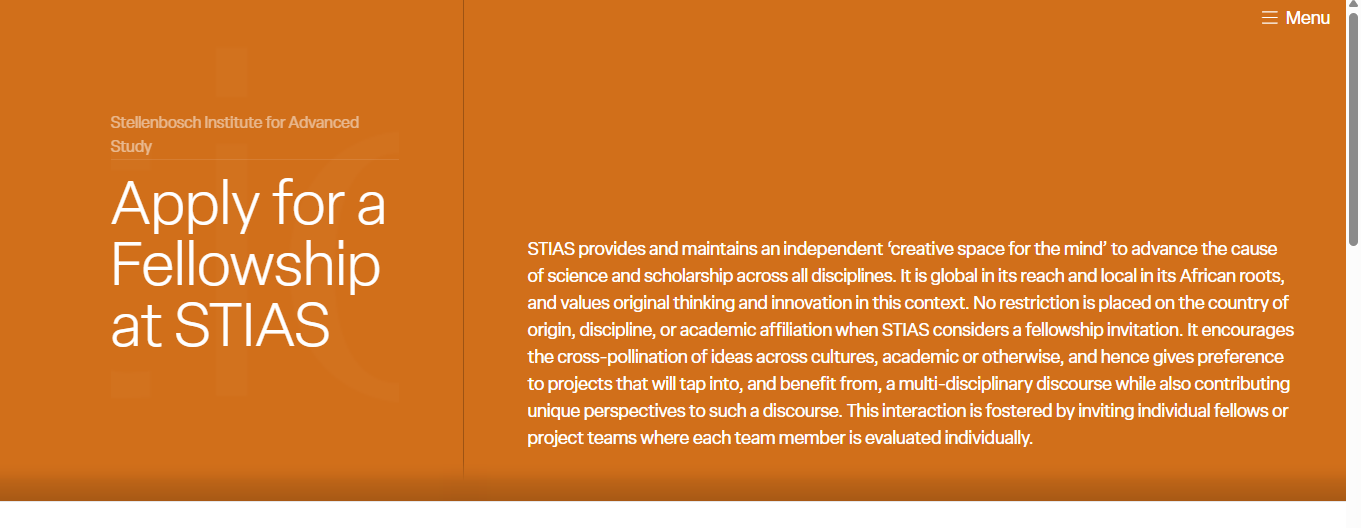
Administered by the Stellenbosch Institute for Advanced Study (STIAS) in South Africa, this fellowship program has been strategically developed to support promising African scholars at a critical stage of their academic careers.
Iso Lomso Fellowships 2026 for Early Career African Researchers
By offering sustained research time, intellectual space, and international exposure, the program seeks to nurture a new generation of established scholars whose work contributes meaningfully to knowledge production in and about Africa.
The name Iso Lomso, which translates to “the eye of tomorrow” in isiXhosa, reflects the core philosophy of the fellowship. It emphasizes foresight, long-term academic vision, and the deliberate laying of foundations for future scholarship.
As a result, the program is not structured as a short-term grant but rather as a three-year developmental attachment that allows fellows to pursue ambitious research agendas while remaining rooted in African institutions.
Fellowship Summary Table
| Category | Details |
| Fellowship Name | Iso Lomso Fellowships 2026 |
| Host Institution | Stellenbosch Institute for Advanced Study (STIAS) |
| Host Country | South Africa |
| Programme Type | Long-term Research Fellowship |
| Duration | Three years (2027–2029) |
| Residency Model | Multiple STIAS residencies (6 weeks to 5 months each) |
| Study Level | Early Career Researchers (Post-PhD) |
| Eligible Applicants | African scholars with academic or research appointments |
| Nationality Requirement | Citizens of any African country |
| Age Requirement | Born after 1 January 1984 |
| Doctoral Degree Requirement | PhD obtained after 1 January 2018 |
| Disciplines Covered | All academic disciplines |
| Funding Type | Fully Funded |
| Application Deadline | 15 February 2026 |
About the Iso Lomso Fellowship Programme
The Iso Lomso Fellowship Programme has been specifically designed for early-career African researchers who are transitioning from postdoctoral training into more independent and established academic roles. Unlike conventional fellowships that focus on short research stays, Iso Lomso offers a structured, multi-year engagement with STIAS. Through this model, fellows are allowed to refine their research vision, strengthen scholarly networks, and produce high-quality academic outputs over time.
Importantly, fellows are not expected to relocate permanently. Instead, they maintain their primary affiliation with their home institution while periodically undertaking residencies at STIAS. In this way, intellectual growth is encouraged without disconnecting scholars from their local academic environments. Consequently, capacity building is achieved not only at the individual level but also within African universities and research institutions more broadly.
All academic disciplines are welcome under this program. Whether in the humanities, social sciences, natural sciences, or interdisciplinary fields, projects are assessed on scholarly merit rather than disciplinary boundaries. Therefore, innovative and cross-cutting research ideas are particularly encouraged.
Objectives of the Iso Lomso Fellowships
The fellowship was established with several interrelated objectives that guide both its structure and selection criteria. First, it aims to support African scholars who have already demonstrated research potential and who are positioned to become leaders in their respective fields. By providing uninterrupted research time, long-term planning becomes possible, which is often difficult to achieve within demanding teaching and administrative environments.
Second, the program seeks to enhance the quality and visibility of African scholarship. Research conducted under Iso Lomso is expected to contribute new perspectives, theories, and data relevant to Africa’s intellectual and developmental priorities. As a result, fellows are encouraged to engage with questions that resonate locally while also advancing global academic debates.
Third, interdisciplinarity is actively promoted. Through STIAS’s diverse scholarly community, fellows are exposed to different methodologies and theoretical approaches. This environment facilitates dialogue across disciplines, thereby enriching research outcomes and fostering intellectual innovation.
Fellowship Structure and Residency Model
One of the defining features of the Iso Lomso Fellowship is its residency-based structure. Rather than a continuous stay, fellows undertake several research residencies at STIAS over three years. These residencies are arranged collaboratively between the fellow, their home institution, and STIAS to ensure flexibility and feasibility.
Typically, the first residency is longer and is scheduled in 2027. This initial period allows fellows to immerse themselves deeply in their research, establish networks at STIAS, and refine their long-term research plans. Two additional residencies then follow through 2029, each lasting between six weeks and five months, depending on the needs of the project.
During these residencies, fellows are fully integrated into the STIAS scholarly community. Daily interactions, seminars, and informal discussions are emphasized, as these are considered essential to intellectual development. Consequently, research progress is often accelerated within this supportive and distraction-free environment.
Eligibility Requirements
To ensure alignment with the program’s goals, strict eligibility criteria have been established. Applicants must be nationals of an African country and must be actively affiliated with a university or research institution based on the continent. Moreover, this affiliation must be ongoing, as the fellowship is designed to strengthen African institutions rather than facilitate academic migration.
In terms of academic qualifications, applicants must have obtained a doctoral degree from a recognized higher education institution after 1 January 2018. Additionally, completion of a postdoctoral fellowship or an equivalent post-PhD research program is required, ensuring that candidates have already undergone advanced research training.
Age eligibility is also specified, with applicants required to have been born after 1 January 1984. Furthermore, candidates must be in a position to commence their first STIAS residency during 2027.
Although research may be conducted in any language, application materials must be submitted in English. This requirement ensures consistency during the evaluation process, particularly given the international composition of selection panels.
Selection Criteria and Evaluation Process
Applications to the Iso Lomso Fellowships are evaluated through a rigorous and competitive process. Several key criteria are applied to assess the quality and suitability of each proposal.
First, academic excellence is examined, with emphasis placed on the applicant’s track record, scholarly potential, and the originality of the proposed research. Second, innovation is assessed, particularly the project’s capacity to generate new knowledge or perspectives.
Third, interdisciplinarity is considered. Projects that draw meaningfully from multiple disciplines or that encourage cross-disciplinary dialogue are viewed favorably. Fourth, relevance to African scholarship is evaluated, ensuring that funded research contributes to intellectual advancement on the continent.
Finally, feasibility is critically assessed. Research designs must be realistic, well-structured, and achievable within the fellowship timeframe. Only projects that demonstrate both ambition and practicality are selected.
Financial Coverage and Fellowship Benefits
The Iso Lomso Fellowships are fully funded, allowing fellows to focus entirely on their research during residency periods. While in residence at STIAS, fellows receive comprehensive support designed to meet both academic and personal needs.
An economy-class return flight is provided for each residency period. Comfortable accommodation located within walking distance of the institute is arranged, thereby minimizing logistical concerns. In addition, fellows are allocated private offices equipped with essential facilities, including computers and internet access.
A monthly stipend is provided to cover daily living expenses. Furthermore, fellows gain full access to the Stellenbosch University library system, including extensive electronic resources. Participation in the STIAS fellows’ program is also included, featuring daily communal lunches, weekly seminars, public lectures, and social events.
For fellows accompanied by young children, a childcare subsidy is made available, reflecting the program’s commitment to inclusivity and work-life balance.
Application Timeline
The application process for the 2026 Iso Lomso Fellowships follows a clearly defined timeline. Applications must be submitted by 15 February 2026. Shortlisting is expected to be completed by 30 April 2026, after which selected candidates may be contacted for additional information if required.
Final selection decisions are scheduled for 31 May 2026, with successful applicants being notified shortly thereafter. Although these dates are indicative, applicants are advised to regularly consult the official fellowship webpage for updates, as timelines may be adjusted.
Application link: https://www.stias.ac.za/fellowships/apply/
MORE RELATED CONTENT:
Turkish Government Scholarships 2026 (Fully Funded)
Hungarian Government Bilateral State Scholarships 2026 (Fully Funded)
University of Oulu Scholarship in Finland 2026
KAS Scholarship 2026 in Germany (Fully Funded)