
The UNESCO Research Continuity Grants for Africa 2026 is a funding opportunity designed to support African researchers whose scientific research activities have been interrupted by conflict, natural hazards, or biological hazards. The initiative is offered under UNESCO’s Science for Crisis Response and Solutions (SCRS) Programme.
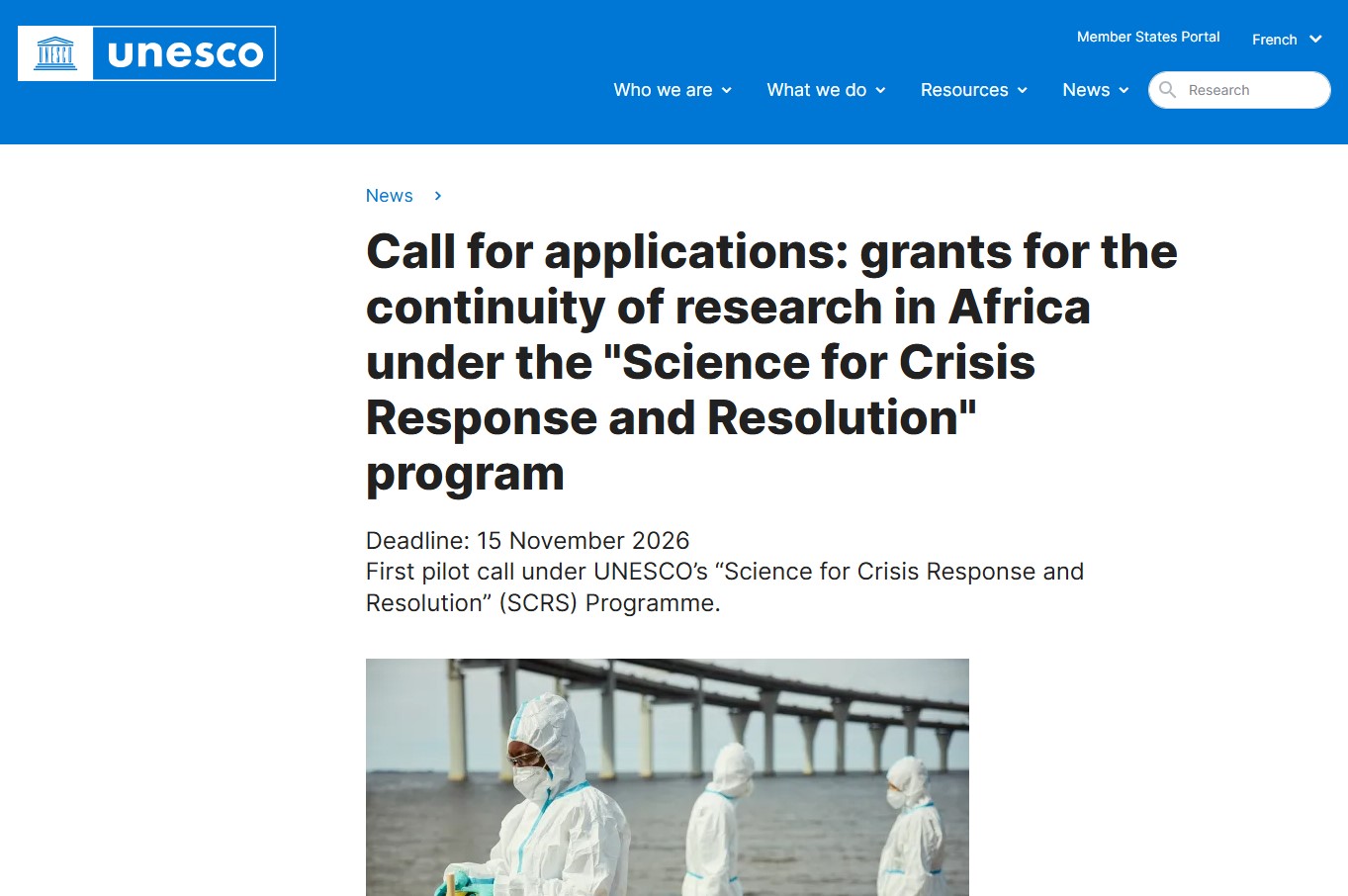
Through this pilot funding initiative, UNESCO will award six institutional research grants worth up to US$2,000 each to eligible researchers affiliated with recognised African universities and research institutions. The funding is intended to help researchers resume or complete specific parts of interrupted research projects, protect valuable scientific data and strengthen research capacity in crisis-affected environments.
The programme supports research in the natural sciences, including interdisciplinary projects with a substantial natural-science component. Also, eligible researchers from African countries are encouraged to apply before the November 2026 deadline.
Overview of the UNESCO Research Continuity Grants for Africa 2026
| Details | Information |
| Grant Name | UNESCO Research Continuity Grants for Africa |
| Programme | Science for Crisis Response and Solutions (SCRS) |
| Organisation | UNESCO |
| Host Region | Africa |
| Grant Type | Institutional Research Grant |
| Number of Grants | 6 |
| Maximum Funding | US$2,000 per grant |
| Eligible Applicants | African researchers |
| Minimum Qualification | Master’s degree or equivalent research qualification |
| Research Areas | Natural Sciences and eligible interdisciplinary research |
| Project Duration | Maximum of 6 months |
| Application Languages | English or French |
| Application Deadline | 15 November 2026 |
| Application Status | Open |
Benefits of the UNESCO Research Continuity Grants for Africa
Successful applicants will receive:
- Research funding of up to US$2,000 per approved project.
- Financial support to resume or complete interrupted research activities.
- Funding for research consumables and small research supplies.
- Support for local fieldwork and research-related travel.
- Financial support for data collection, processing, and secure storage.
- Support for minor equipment repairs.
- Short-term access to essential research equipment and facilities.
- Support for laboratory expenses.
- Funding for eligible research publication and open-access costs.
- Opportunities to preserve valuable scientific data and research capacity.
- Support for strengthening scientific research resilience in African institutions.
The grant does not cover personal salaries, honoraria, personal allowances, long-term living expenses, relocation abroad, major equipment purchases, construction projects, or institutional overheads.
UNESCO Research Continuity Grants Research Areas
The UNESCO Research Continuity Grants support research in natural sciences and eligible interdisciplinary research involving a substantial natural-science component.
Relevant research areas include:
Biological Sciences
Research involving biological systems, biodiversity, ecology and other areas of natural science.
Environmental Sciences
Research addressing environmental challenges, ecosystem protection and the effects of natural hazards.
Climate and Earth Sciences
Research involving climate-related challenges, natural hazards and environmental changes.
Physical Sciences
Research involving physics, chemistry and other relevant natural-science disciplines.
Interdisciplinary Natural Sciences
Research combining natural sciences with other disciplines, provided the project has a substantial natural-science component.
The proposed activities must directly relate to research that was interrupted by conflict or natural or biological hazards.
UNESCO Eligibility Requirements
To qualify for the UNESCO Research Continuity Grants for Africa 2026, applicants must meet the following requirements:
- Applicants must be nationals of an African country.
- Applicants must be affiliated with a recognised university or research institution located in an African country.
- Applicants must hold at least a Master’s degree or an equivalent recognised research qualification in a relevant field.
- Applicants must be conducting research in the natural sciences or eligible interdisciplinary research with a substantial natural-science component.
- Applicants must demonstrate that their research was interrupted by armed conflict, a natural hazard or a biological hazard within the past three years, or continues to be significantly affected by the consequences of such an event.
- Proposed research activities must be achievable within a maximum period of six months.
- The proposed budget must not exceed US$2,000.
- Applicants must provide a signed institutional support letter from an authorised representative of their host institution.
- Applicants must confirm that the same proposed expenses are not receiving funding from another source.
- Applicants must provide any necessary ethical, research or fieldwork authorisations for their proposed activities.
UNESCO particularly encourages applications from women scientists, researchers below 40 years of age, and researchers from African least developed countries and small island developing states.
How to Apply for the UNESCO Research Continuity Grants for Africa 2026
Interested researchers should follow these steps:
- Visit the official UNESCO website and access the Research Continuity Grants for Africa 2026 announcement.
- Read the official call for applications, terms of reference, and concept note carefully.
- Confirm that the proposed research meets the eligibility requirements and addresses research activities interrupted by a qualifying crisis.
- Complete and sign the official application form in English or French.
- Prepare an updated curriculum vitae.
- Attach evidence of the highest relevant academic or research qualification.
- Obtain a signed institutional support letter from an authorised representative of the host university or research institution.
- Include any required ethical, research or fieldwork authorisations.
- Ensure that the proposed activities can be completed within six months and that the budget does not exceed US$2,000.
- Submit the completed application through the official UNESCO online application form before the deadline.
UNESCO Research Continuity Grants Application Deadline
The application deadline for the UNESCO Research Continuity Grants for Africa 2026 is 15 November 2026 at 11:59 p.m. Paris time. Going further, Applicants are advised to complete their applications early and ensure that all supporting documents are included before submission.
UNESCO Official Website
For complete information about the UNESCO Research Continuity Grants for Africa 2026, including the application form, eligibility criteria, and supporting documents, visit the official UNESCO website:
UNESCO Research Continuity Grants for Africa 2026 – Official Website
Moreover, applicants can access the English application form through the official announcement.
Frequently Asked Questions
How much funding does the UNESCO Research Continuity Grants programme provide?
Each selected research project can receive a maximum of US$2,000. UNESCO plans to award six grants under this pilot initiative.
Can Nigerian researchers apply?
Yes, Nigerian researchers can apply because the programme welcomes eligible researchers from all African countries. However, applicants must satisfy the institutional affiliation, academic qualification, and research-interruption requirements.
What type of research does the programme support?
The programme supports natural-science research, including interdisciplinary projects with a substantial natural-science component, that has been interrupted by conflict or natural or biological hazards.
How long can funded research projects last?
The proposed research activities must be completed within a maximum period of six months.
CHECK THESE OUT:
Lester B. Pearson International Scholarship 2027 in Canada (Fully Funded)
EPFL Excellence Research Internship 2027 in Switzerland (CHF 1,800 Monthly Scholarship)
EPFL Life Sciences Summer Research Program 2027 in Switzerland (Funded)