
The University of Oxford Research Council Scholarships 2027 offer postgraduate research funding opportunities for eligible students pursuing doctoral degrees and other research programmes in the United Kingdom. Funded through UK Research and Innovation (UKRI) and its research councils, these opportunities support research across the humanities, biological sciences, engineering, social sciences, medicine, environmental sciences and physics.
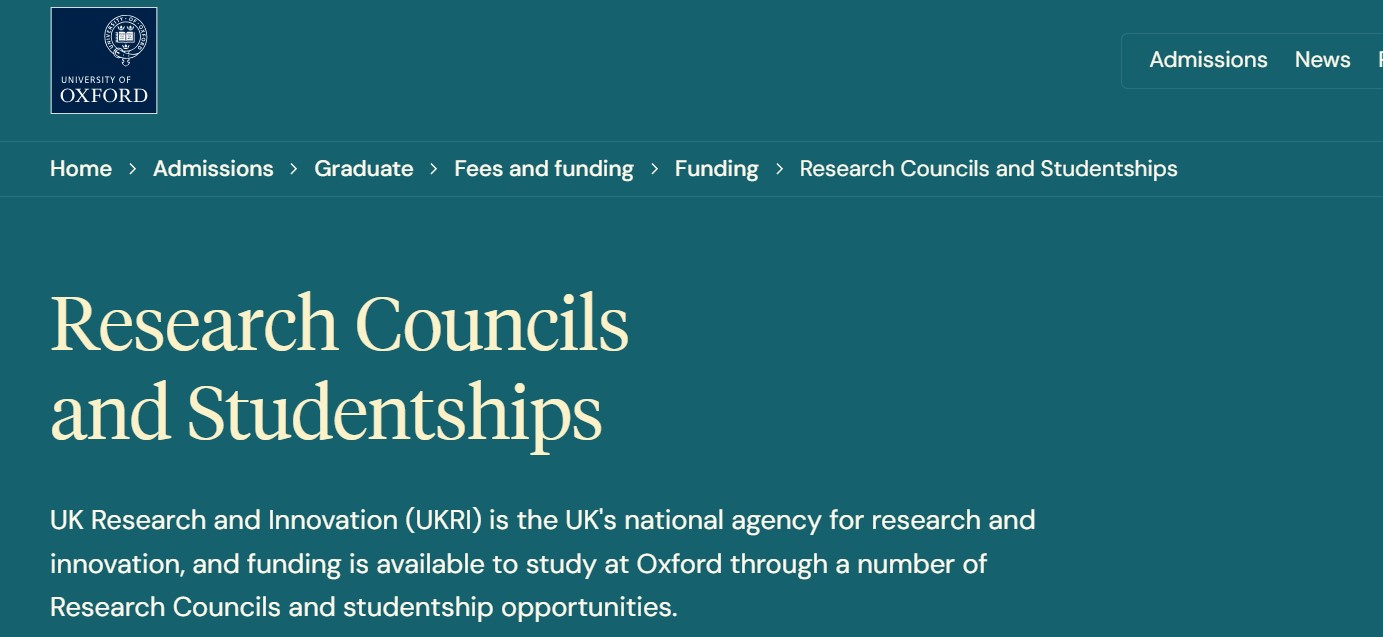
Depending on the award, students may receive funding for tuition fees and a living-cost stipend. Oxford participates in several research council funding programmes, including doctoral landscape awards, doctoral training partnerships and department-specific studentships.
Both UK and international applicants may be eligible. However, funding conditions, international student limits and application deadlines vary by programme. Students interested in 2027 entry should review the official Oxford funding pages and their chosen department’s requirements before applying.
University of Oxford Research Council Scholarships 2027: Summary
| Scholarship detail | Information |
|---|---|
| Funding programme | Oxford Research Councils and Studentships |
| Host university | University of Oxford |
| Country | United Kingdom |
| Funding body | UK Research and Innovation (UKRI) and its research councils |
| Study level | Primarily doctoral and postgraduate research |
| Eligible fields | Humanities, biosciences, engineering, social sciences, medicine, environmental sciences and physical sciences |
| Funding benefits | Tuition fees, living stipend or other studentship support, depending on the award |
| Eligible applicants | UK and international students, subject to individual award rules |
| International student limit | UKRI normally limits international appointments to 30% within individual doctoral training programmes |
| Application method | Through the relevant Oxford graduate course, doctoral training programme or department |
| Main deadlines | Vary by research council, course and studentship |
| Official website | https://www.ox.ac.uk/admissions/graduate/fees-and-funding |
What Are the University of Oxford Research Council Scholarships?
The University of Oxford Research Council Scholarships are funding opportunities supported by UKRI research councils and associated doctoral training programmes. They help postgraduate researchers undertake advanced study and research at Oxford.
UKRI is the UK’s national agency for research and innovation. Its research councils support postgraduate studentships in different academic disciplines, helping universities train researchers and develop new knowledge.
At Oxford, these opportunities include funding linked to the Arts and Humanities Research Council (AHRC), Biotechnology and Biological Sciences Research Council (BBSRC), Engineering and Physical Sciences Research Council (EPSRC), Economic and Social Research Council (ESRC), Medical Research Council (MRC), Natural Environment Research Council (NERC) and Science and Technology Facilities Council (STFC).
The funding structure depends on the programme. Some awards support a specific research project, while others are offered through doctoral training partnerships or broader doctoral landscape awards.
Benefits of Oxford Research Council Scholarships
The financial support available depends on the research council and the specific studentship.
1. Tuition Fee Support
UKRI-funded studentships generally include tuition fees up to the relevant research council’s UK fee rate. Applicants should check whether their award covers the full fee charged to an international student, as overseas fees may be higher.
2. Living-Cost Stipend
Eligible studentships provide a living stipend to help doctoral researchers cover everyday expenses while studying.
The amount and duration depend on the particular award. Applicants should consult the relevant funding programme for the current stipend rate.
3. Research and Academic Training
Successful candidates may receive specialist research training, academic supervision and access to facilities, depending on their department and doctoral programme.
Some studentships also provide opportunities to collaborate with external research organisations or industry partners.
4. Different Funding Structures
Oxford’s research council opportunities include several types of support:
- Full studentships covering eligible fees and living costs.
- Fees-only awards.
- Doctoral training programmes with structured research training.
- Project-specific studentships.
- College partnership awards linked to research council funding.
Applicants should read the individual award conditions carefully before assuming that a scholarship covers all expenses.
Research Council Scholarships Available at Oxford
Oxford offers research council funding across several academic disciplines. The main programmes are outlined below.
1. Arts and Humanities Research Council (AHRC)
The AHRC supports research in the arts and humanities, including subjects such as literature, history, languages, philosophy and related disciplines.
Oxford participates in AHRC Doctoral Landscape Awards, which provide a limited number of scholarships across humanities subject areas between 2026 and 2030.
For consideration under the published arrangements, applicants should submit their DPhil course application by the relevant early January deadline.
Students should confirm which courses and awards are available for their intended entry year.
Official website: https://www.ukri.org/councils/ahrc/
2. Biotechnology and Biological Sciences Research Council (BBSRC)
The BBSRC funds research and postgraduate training in biological sciences. Its research areas include biological systems, bioscience and related applications.
At Oxford, BBSRC studentships, including Industrial CASE opportunities, are awarded primarily through the Oxford Interdisciplinary Life and Environmental Landscape Award.
These opportunities may suit students interested in biological research, life sciences and related interdisciplinary fields.
For funding enquiries, Oxford lists the following contact address: enquiries@ilesla.ox.ac.uk.
Official website: https://www.ukri.org/councils/bbsrc/
3. Engineering and Physical Sciences Research Council (EPSRC)
The EPSRC supports research and postgraduate training in engineering, mathematics, computing and the physical sciences.
Applicants to doctoral research programmes within the EPSRC remit may be considered automatically for EPSRC Doctoral Landscape Award funding, subject to the applicable programme rules.
Oxford also hosts Centres for Doctoral Training and other doctoral training opportunities. Some industrial studentships are advertised separately, often between November and January.
Students should search Oxford’s postgraduate course listings and relevant department websites for current opportunities.
Official website: https://www.ukri.org/councils/epsrc/
4. Economic and Social Research Council (ESRC)
The ESRC funds research in economics, sociology, politics and other social science disciplines.
Oxford participates in the Grand Union Doctoral Training Partnership alongside Brunel University of London and the Open University.
The partnership offers different award structures and study durations, including full-time and part-time routes. Depending on the pathway, applicants may be able to undertake doctoral research without already holding a master’s degree.
To be considered for an ESRC Grand Union DTP studentship, applicants must select ESRC Grand Union DTP in the University of Oxford graduate application form’s scholarship section.
Applicants must also complete the partnership’s studentship application form and submit it with a full CV and their graduate application by the relevant funding deadline.
Official website: https://www.granduniondtp.ac.uk/
5. Medical Research Council (MRC)
The MRC supports research into medical and related sciences, including work aimed at improving health, preventing illness and advancing medical knowledge.
Oxford receives MRC funding through its Centres of Research Excellence and partnerships with national Doctoral Landscape Awards.
Funding opportunities may be advertised on departmental websites and through the Oxford-MRC Doctoral Training Partnership.
Oxford’s published guidance identifies 1 December 2026 as the deadline for many MRC-funded projects for the 2027 entry cycle, although some projects may have different deadlines.
Applicants should check each project’s official advertisement before applying.
Official website: https://www.ukri.org/councils/mrc/
6. Natural Environment Research Council (NERC)
The NERC funds research and training in environmental sciences, including atmospheric science, Earth science, terrestrial and aquatic environments, and biological systems.
At Oxford, NERC funding is awarded primarily through the Interdisciplinary Life and Environmental Sciences Landscape Award.
These opportunities may be suitable for students interested in environmental research, ecology, climate-related studies and other relevant disciplines.
For funding enquiries, Oxford lists enquiries@ilesla.ox.ac.uk.
Official website: https://www.ukri.org/councils/nerc/
7. Science and Technology Facilities Council (STFC)
The STFC supports research in areas including particle physics, nuclear physics, astronomy, space science, laser science and materials science.
Oxford funding opportunities linked to STFC are advertised through relevant academic departments.
Students interested in physics, space research or related scientific fields should review department-specific announcements and the available postgraduate research courses.
Official website: https://www.ukri.org/councils/stfc/
Oxford Research Councils College Partnership Awards
In addition to direct research council funding, Oxford offers College Partnership Awards linked to certain research council studentships.
These awards are jointly funded through research council support and participating colleges, helping make additional postgraduate research funding available.
There is no separate application process for the College Partnership Awards. Eligible graduate candidates who receive a qualifying Research Council studentship are considered under the relevant arrangements.
Successful applicants may be transferred to a participating college offering a partnership award, even if they originally selected another college.
Important: College Partnership Awards are tenable only at the college providing the funding. Check the applicable award conditions before accepting an offer.
What Are Oxford Research Studentships?
A studentship provides financial support for a postgraduate researcher working on a particular project, research area or doctoral programme.
Funding may come from a research council, academic department, college or external organisation.
Oxford studentships may provide full funding or cover tuition fees only. Some are attached to named research projects, while others form part of a doctoral training programme.
Students should check the relevant department’s website for current vacancies, eligibility requirements, funding details and application instructions.
Who Can Apply for Oxford Research Council Scholarships?
Eligibility depends on the research council, studentship and doctoral programme.
UK Students
UK applicants may be eligible for research council funding if they meet the relevant academic, residency and programme requirements.
International Students
International students can also apply for many UKRI-funded opportunities. However, UKRI normally limits the proportion of international students appointed through individual doctoral training programmes to 30% of the total.
This is a programme-level limit, not a guarantee that 30% of places will be available to international applicants in every competition.
International students should also check whether the award covers the full overseas tuition fee or only the applicable UK fee rate. Additional funding may be necessary if the award does not cover the entire international fee.
Academic Requirements
Applicants generally need to meet the entry requirements for their chosen Oxford graduate course. Depending on the programme, requirements may include:
- Relevant academic qualifications.
- Academic transcripts and certificates.
- References.
- A research proposal or statement of purpose.
- A CV and evidence of research experience.
- English-language test results, where required.
Individual programmes may impose additional requirements.
How to Apply for University of Oxford Research Council Scholarships 2027
The application process varies according to the research council and studentship.
Step 1: Find an Eligible Oxford Graduate Course
Search Oxford’s official postgraduate course directory to identify a suitable DPhil or other eligible research programme.
Official course directory: https://www.ox.ac.uk/admissions/graduate/courses
Step 2: Identify the Relevant Funding Programme
Determine whether your intended research area is supported by AHRC, BBSRC, EPSRC, ESRC, MRC, NERC or STFC funding.
Check the course page, relevant doctoral training partnership and department website for available studentships.
Step 3: Review the Funding Requirements
Read the eligibility rules, funding coverage, application deadlines and any additional forms required.
For example, ESRC Grand Union DTP applicants must complete a separate studentship application form and select the appropriate funding option in Oxford’s graduate application form.
Other programmes may use different procedures.
Step 4: Prepare Your Documents
Prepare your academic transcripts, CV, references, research proposal and any other required supporting materials.
Ensure your documents meet the instructions for both your graduate course and the relevant funding opportunity.
Step 5: Complete the Oxford Graduate Application
Submit your application through Oxford’s graduate admissions system and follow any additional departmental or doctoral training partnership instructions.
Some studentships require applicants to enter a funding code or select a specific scholarship option. Where a separate application is required, complete it before the funding deadline.
Step 6: Submit Before the Correct Deadline
Deadlines vary between research councils, doctoral training partnerships and individual projects.
For example, some AHRC opportunities use the early January course deadline, while many MRC-funded projects for 2027 entry have a published deadline of 1 December 2026.
For more details, click here.
Important Deadlines for Oxford Research Council Funding 2027
Applicants should pay close attention to funding deadlines because they may be earlier than the final course admission deadline.
| Funding opportunity | Deadline guidance |
|---|---|
| AHRC Doctoral Landscape Awards | Early January course deadline under the published arrangements |
| BBSRC studentships | Check the Oxford Interdisciplinary Life and Environmental Landscape Award |
| EPSRC Doctoral Landscape Awards | Check the relevant course and funding instructions |
| ESRC Grand Union DTP | Check the partnership’s funding deadline |
| MRC-funded projects | Many 2027-entry opportunities list 1 December 2026; individual deadlines may differ |
| NERC studentships | Check the Interdisciplinary Life and Environmental Landscape Award |
| STFC studentships | Check the relevant academic department |
| College Partnership Awards | Eligible candidates are considered through qualifying research council studentships |
Deadlines and funding availability can change. Applicants should use the official funding pages rather than relying solely on third-party scholarship listings.
Tips for Securing an Oxford Research Studentship
- Choose a relevant research area. Identify a programme that closely matches your academic background and proposed research interests.
- Read the funding instructions carefully. Some awards require a separate form, funding code or additional application materials.
- Prepare a strong research proposal. Where required, explain your research question, methodology, objectives and the significance of your proposed work.
- Contact the department when necessary. Departmental admissions teams and doctoral training partnerships can clarify programme-specific requirements.
- Apply early. Preparing documents and contacting referees well in advance can help you avoid missing an important funding deadline.
FAQs
Are Oxford Research Council Scholarships fully funded?
Some studentships cover tuition fees and living costs, while others provide fees-only support or have different funding arrangements. Check the individual award details before applying.
Can international students apply for Oxford research council funding?
Yes, international students are eligible for many UKRI-funded studentships, subject to individual programme requirements and the international appointment limit.
Which subjects are covered?
Funding is available across the humanities, biological sciences, engineering, social sciences, medical research, environmental sciences, physics and related disciplines.
What is the deadline for Oxford Research Council Scholarships 2027?
There is no single deadline for every research council. Some opportunities use early January deadlines, while many MRC-funded projects for 2027 entry list 1 December 2026. Confirm the deadline for your chosen programme.
CHECK THESE OUT:
UCL Clara Collet PhD Scholarship 2027/28 in the UK – Fully…
France Excellence Eiffel Scholarship 2027 – Apply Now
University of Leicester Global Excellence Scholarship 2026-2027: £7,000 Tuition-fee Discount
Glendon Chase McCormick Scholarship 2026: $4,000 for Master’s and PhD Students…
NSHSS Performing Arts: Dance Scholarship 2026: Win $2,000