
The Francis Crick Institute PhD Programme 2027 offers an opportunity for talented researchers to pursue a fully funded PhD in biomedical sciences in London, United Kingdom. The programme is designed for graduates who want to investigate fundamental questions in biology and medicine while working with leading scientists in a world-class research environment.
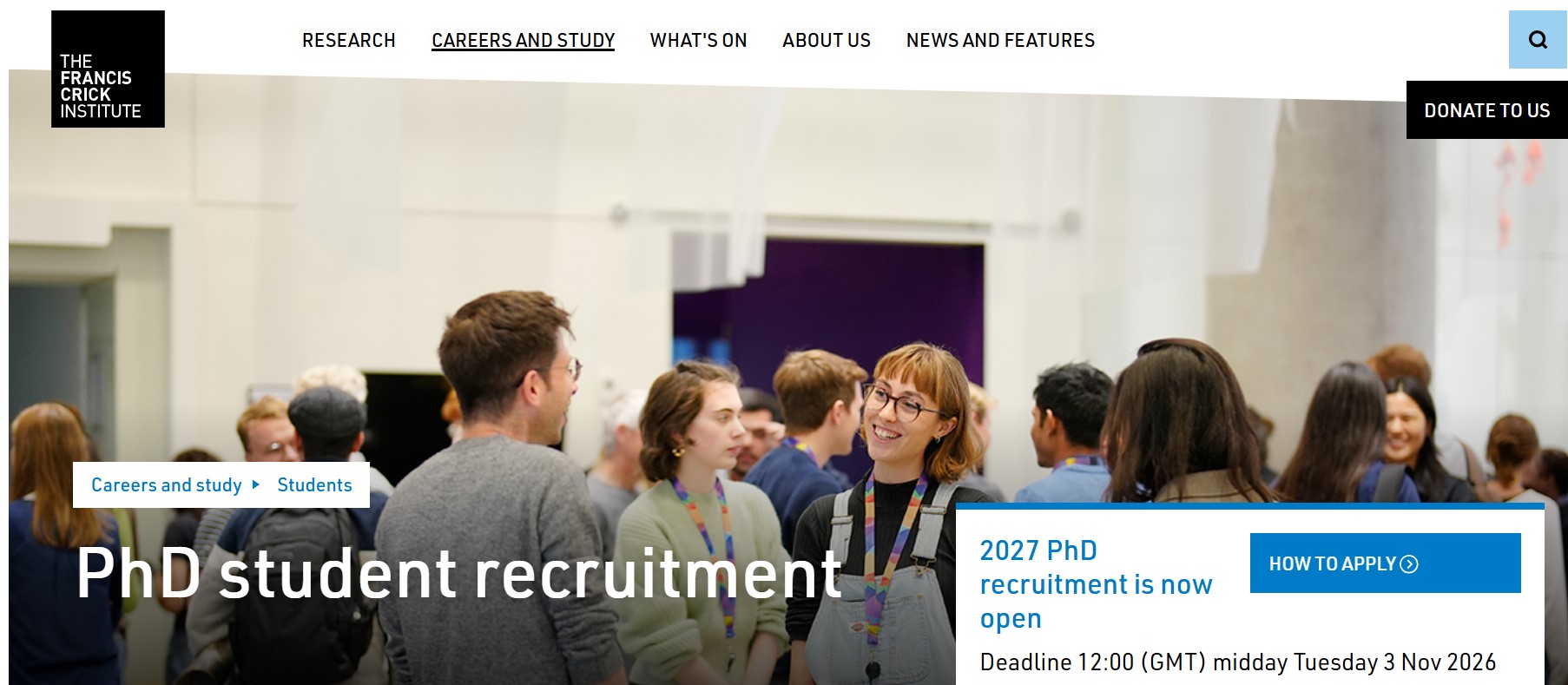
The 2027 recruitment round is open to eligible applicants from around the world through the standard PhD student recruitment route. Successful candidates receive a four-year studentship that includes a tax-free annual stipend, tuition fees and research support. Eligible international students may also receive reimbursement of their student visa application fee and Immigration Health Surcharge.
The application deadline is November 3, 2026, at 12:00 noon GMT. Referees have a separate deadline of November 10, 2026, at 12:00 noon GMT, according to the published recruitment information. Applicants should not confuse the reference deadline with the deadline for submitting their own applications.
Francis Crick Institute PhD Programme 2027: Overview
| Scholarship detail | Information |
|---|---|
| Programme name | Francis Crick Institute PhD Programme 2027 |
| Host institution | The Francis Crick Institute |
| Study destination | London, United Kingdom |
| Degree level | PhD / Doctoral research |
| Research areas | Biomedical sciences and related disciplines |
| Eligible nationalities | All nationalities for the standard recruitment route |
| Programme duration | Four years |
| Annual stipend | £27,715 tax-free per year |
| Tuition fees | Covered, including international tuition fees |
| Research costs | Research support provided as part of the studentship |
| Visa support | Eligible candidates may receive reimbursement of the student visa application fee and Immigration Health Surcharge |
| Programme start date | September 27, 2027 |
| Application deadline | November 3, 2026, at 12:00 noon GMT |
| Referee deadline | November 10, 2026, at 12:00 noon GMT |
| Application method | Online application through the official recruitment portal |
| Official application page | https://www.crick.ac.uk/careers-study/students/phd-student-recruitment |
What Is the Francis Crick Institute PhD Programme?
The Francis Crick Institute is a biomedical research institute in London that brings together scientists from different disciplines to investigate the biological mechanisms underlying health and disease.
Its PhD programme allows doctoral researchers to work on research projects under the supervision of experienced scientists. Students benefit from access to advanced research facilities, specialist technologies, scientific collaboration and professional development opportunities.
The programme is intended for candidates with a strong interest in research and the academic preparation needed to undertake doctoral-level work.
Research projects may cover areas such as genetics, molecular biology, neuroscience, immunology, cancer biology, infectious diseases, cell biology and other fields connected to biomedical science. The precise projects available depend on the laboratories recruiting for the 2027 intake.
Benefits of the Francis Crick Institute PhD Studentship 2027
The programme provides financial and research support throughout the funded doctoral studentship.
1. Annual Tax-Free Stipend of £27,715
Successful candidates receive a £27,715 tax-free stipend per year for four years, according to the published 2027 recruitment information.
The stipend is intended to help students meet living expenses during their doctoral studies, including accommodation, food, transport and other personal costs.
Over four years, the stated annual rate amounts to £110,860 before any future changes to the stipend rate. This is a calculation of the advertised annual allowance multiplied by four, not a separate cash award.
Students should budget carefully because living expenses in London can be substantial.
2. Tuition Fees Covered
The studentship covers tuition fees, including the international fee rate.
This is particularly important for applicants from outside the United Kingdom, who might otherwise face higher university tuition costs.
Candidates should confirm the exact fee arrangements in their formal studentship offer.
3. Research Costs and Facilities
PhD students undertake research within the institute’s scientific environment and receive support for their approved research projects.
Access to specialist facilities and scientific expertise allows students to develop practical research skills, analyse data and contribute to investigations in biomedical science.
Research funding is intended to support the approved doctoral project. It should not be treated as unrestricted money paid directly to the student.
4. Eligible Visa and Immigration Health Surcharge Reimbursement
International candidates who require a UK student visa may be eligible for reimbursement of the student visa application fee and Immigration Health Surcharge, subject to the programme’s conditions.
Applicants should confirm the reimbursement process and any exclusions directly with the institute before making financial commitments.
5. Four Years of Doctoral Research Training
The studentship provides a four-year research training opportunity beginning in September 2027.
Students work on a doctoral project while developing scientific, analytical and communication skills. They may also benefit from the institute’s wider training and career development opportunities.
The programme can prepare graduates for future careers in academic research, biotechnology, pharmaceutical research and other science-related fields.
Who Can Apply for the Francis Crick Institute PhD Programme 2027?
The standard PhD recruitment route is open to candidates of all nationalities who meet the academic and research experience requirements.
The usual academic eligibility criteria include:
- A first-class or upper second-class honours degree, or an equivalent qualification from a non-UK university, in a relevant subject.
- Appropriate research experience gained during a university degree or through other relevant research activities, or a master’s degree in a relevant subject.
Applicants whose undergraduate degree is equivalent to a lower second-class honours degree should check the programme’s current requirements carefully, particularly whether a relevant master’s qualification is required for their circumstances.
Some individual projects may have additional eligibility criteria because of the funding supporting the position. Where applicable, these requirements should be stated on the individual project page.
Meeting the minimum requirements does not guarantee admission. Applications are assessed competitively.
Can International Students Apply?
Yes. The standard Francis Crick Institute PhD recruitment route is open to eligible applicants of all nationalities.
International applicants must meet the academic requirements and demonstrate the research experience needed for their chosen project.
The studentship covers tuition fees at the international rate, alongside the advertised stipend and research support. Eligible candidates may also receive reimbursement of specified visa-related expenses.
Applicants from Nigeria, India, Ghana, Pakistan and other countries can therefore consider applying if their qualifications and research interests match the programme’s requirements.
However, international applicants should check their visa requirements, the conditions attached to any reimbursement and the eligibility criteria of the individual project they select.
Do Applicants Need IELTS or Other English-Language Evidence?
Applicants should not assume that English-language evidence must be submitted with the initial application.
The published recruitment information indicates that applicants do not need to submit English-language evidence during the application stage. Candidates who receive a studentship offer are provided with information about the applicable English-language requirements.
International applicants should follow the institute’s instructions and prepare any required evidence if they progress to the offer stage.
Research Areas Available for the 2027 Intake
The Crick’s research focuses on understanding fundamental biology and how biological processes relate to human health and disease.
Depending on the available projects, applicants may find opportunities in areas including:
- Cancer biology: Understanding the mechanisms involved in cancer development and progression.
- Genetics and genomics: Investigating genes, genetic variation and biological regulation.
- Immunology: Studying immune responses and their role in health and disease.
- Neuroscience: Exploring the function and development of the nervous system.
- Infectious diseases: Investigating pathogens and the biological mechanisms behind infection.
- Cell and molecular biology: Understanding how cells function, communicate and respond to changes.
- Computational and quantitative biology: Applying computational approaches to biological questions.
These are broad examples of research areas associated with the institute, not a confirmed list of available PhD vacancies. Applicants must review the actual 2027 project listings to identify laboratories recruiting students.
How to Apply for the Francis Crick Institute PhD Programme 2027
Applications should be submitted through the official Francis Crick Institute recruitment process.
Step 1: Visit the Official PhD Recruitment Page
Open the institute’s official website to review the 2027 recruitment information, application instructions and available research projects.
Official application page: https://www.crick.ac.uk/careers-study/students/phd-student-recruitment
Step 2: Review the Available PhD Projects
Study the advertised research projects and identify those that match your academic background, research experience and scientific interests.
Read the project description carefully, including any additional eligibility criteria specified by the recruiting laboratory or funding source.
Step 3: Check Your Academic Eligibility
Confirm that your degree qualifications meet the institute’s requirements.
Applicants should also assess whether their previous research experience is suitable for doctoral study. Relevant experience may have been obtained through a dissertation, laboratory placement, research assistantship, master’s programme or other appropriate research activity.
Step 4: Prepare Your Application
Follow the official application instructions and provide the information and supporting documents requested by the institute.
Ensure that your academic history, research experience and reasons for applying are clearly presented. Avoid making unsupported claims about your experience or qualifications.
Step 5: Submit Before the Deadline
Submit your application by November 3, 2026, at 12:00 noon GMT.
Do not wait until the final hours to complete the submission. Allow enough time to check your information and ensure that the application has been received.
Step 6: Ask Your Referees to Submit Their References
Your referees must follow the institute’s reference instructions and submit their references by the separate deadline of November 10, 2026, at 12:00 noon GMT.
Contact your referees early so they have enough time to prepare and submit their references.
Step 7: Prepare for the Selection Process
Applicants who progress through the selection process may be invited to interviews and other recruitment activities.
Be prepared to discuss your scientific interests, previous research experience, understanding of the proposed project and motivation for pursuing a PhD at the Crick.
Follow the official recruitment communications for the precise interview format and schedule.
Francis Crick Institute PhD Programme 2027: Important Dates
| Event | Date |
|---|---|
| Applications open | October 2026 recruitment round |
| Application deadline | November 3, 2026, at 12:00 noon GMT |
| Referee reference deadline | November 10, 2026, at 12:00 noon GMT |
| Programme commencement | September 27, 2027 |
Applicants should use the official recruitment page for any subsequent updates to the timeline.
FAQs
1. Is the Francis Crick Institute PhD Programme 2027 fully funded?
The advertised studentship covers tuition fees, a £27,715 annual tax-free stipend for four years and research support. Eligible international students may also receive reimbursement of specified visa-related expenses.
2. What is the application deadline?
The deadline is November 3, 2026, at 12:00 noon GMT.
3. When is the referee deadline?
Referees must submit their references by November 10, 2026, at 12:00 noon GMT, according to the published recruitment information.
4. Can Nigerian students apply?
Yes. Nigerian applicants can apply through the standard route if they meet the academic and research experience requirements and satisfy any additional conditions attached to their chosen project.
CHECK THESE OUT:
Friedrich Ebert Foundation Scholarships 2027 in Germany | Funded Study Opportunities
UCL Telles Foundation Scholarship 2027 in the UK | Fully Funded Undergraduate Opportunity
UCL Clara Collet PhD Scholarship 2027/28 in the UK – Fully Funded